


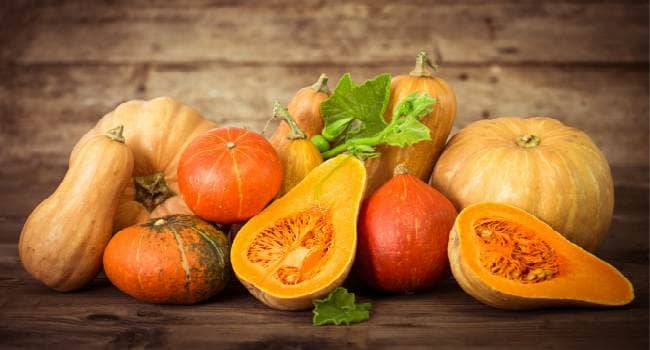


Pumpkin is one of the last autumn vegetable crops. In addition to household purposes, they are used in cooking. A variety of dishes are prepared from it, from soups to candied fruits. In addition to its taste, it has many useful properties. The use of this product will bring invaluable benefits to the body.
Among all varieties, nutmeg pumpkin is in special demand. It is characterized by a more pleasant and sweet taste. Another plus is the storage duration, which allows it to be used throughout the entire winter period.
What does it look like
Butternut squash is one of the varieties of annual herbaceous plants from the pumpkin family. Scientific name in Latin Cucurbita moschata.
This is an annual vegetable, with creeping whips up to 5 meters long, with antennae with which it clings to the support.
The stem is strong, cylindrical or pentagonal, with petioles 12-30 centimeters in size. The stem and leaves are hairy.
The leaves are large. Most often lobed, wavy, or with denticles along the edges. There may be white spots on the leaf plate.
The flowers are large, yellow. Bell-shaped, up to 12 centimeters in size.
Vegetable fruits are most often pear-shaped. Depending on the variety, they can be cylindrical, flattened, oval or dumbbell-shaped. Covered with a thin skin of pale orange, orange, green. The weight of one fruit reaches from 3 to 15 kilograms. The pulp is dark yellow, orange or pale yellow.
Seeds contain much less than a regular round pumpkin.
The homeland of the plant is the territory of Central America (more precisely, Mexico).
It is widely cultivated in Peru, Colombia, Mexico, and Asian countries. It was introduced to Europe only in the 18th century.
Despite its tropical origin, it has taken root in our weather conditions. In Russia, the most popular varieties are Zhemchuzhina, Vita, Vitaminnaya and Hokaido.
Grows best in rich, well-drained soil and a sunny location.
Beneficial features
Butternut squash is a source of many beneficial nutrients. Its pulp contains:
Water (almost 90%);
Vegetable proteins;
Fat (only 0.1 g);
Fatty acids: omega-3, omega-6 and omega-9, palmitic, stearic, linoleic and linolenic;
Digestible carbohydrates (fructose, sucrose, glucose, mono- and disaccharides);
Essential amino acids: valine, arginine, isoleucine, histidine, leucine, threonine, tryptophan, methionine, lysine, phenylalanine;
Substitute amino acids: glutamic, aspartic acid, alanine, proline, glycine, cysteine, tyrosine and serine;
Fiber (food fiber);
Ash product;
Lutein;
Zeaxanthin;
Retinol (vitamin A);
Alpha-carotene;
Provitamin A (beta-carotene);
Beta-cryptoxanthin;
B vitamins (pyridoxine, thiamine, riboflavin, nicotinic, pantothenic and folic acids);
Ascorbic acid (vitamin C);
Alpha-tocopherols (total vitamin E);
Vitamin K (phylloquinone) regulating blood clotting;
Macronutrients – magnesium, calcium, potassium, sodium, phosphorus, manganese, copper, iron, selenium and zinc.
The calorie content of 100 grams of fresh pulp does not exceed 45 kilocalories.
Read on: Pumpkin benefit and harm
Benefits for the human body
To get the most out of your pumpkin, it is best to eat it fresh. It is useful for:
Cleansing the vascular system;
Blood pressure normalization;
Elimination of cholesterol;
Reducing the risk of vascular diseases (myocardial infarction, stroke);
Prevention of the development of atherosclerosis;
Treating heart failure;
An increase in the number of red blood cells (that is, an increase in hemoglobin);
Treatment of ENT diseases;
Improving blood quality;
Relief from dizziness;
Relief of chronic weakness;
Strengthening bone tissue (bones and tooth enamel);
Prevention of negative reactions of the body to cold and rainy weather;
Prevention of allergic reactions in pregnant women and nursing mothers;
Rapid suppression of hunger;
Improvement of vision (there is more carotene in pumpkin than in carrots);
Eliminate eye fatigue;
Retinal Detachment Prevention;
Slowing down the aging process;
Elimination of toxic substances, toxins and free radicals from the body;
Acceleration of metabolic processes (as a result – a decrease in body weight);
Eliminate kidney and bladder problems;
Removal of stagnant liquid (the pulp has a mild diuretic effect);
Prevention of the appearance of cancer cells.
As a source of beta-cryptoxanthin, it has anti-inflammatory properties. In addition, it contains a large number of compounds that impart antioxidant properties.
Seeds contain a lot of zinc. This mineral is especially beneficial for men. Prevents the development of prostatitis. Relieves difficulty urinating associated with an enlarged prostate.
Also prevents the formation of kidney stones.
Cooking applications
This type of pumpkin has a sweet, delicate flesh and a pleasant taste. It can be used to prepare:
Зепеканки;
Vegetable stew;
Stuffed dishes;
Soups;
Jams;
Jam;
Aladdin;
Various dessert dishes.
The fruits are pickled, canned, candied fruits are made. Oil is squeezed out of the seeds.
Contraindications and harm
Refers to food products that are allowed for almost everyone. So nutritionists say. But doctors warn that you need to be very careful with him:
Suffering from diabetes mellitus of both the first and the second type (due to the high content of sugars and carbohydrates);
Those who have a stomach or duodenal ulcer (mostly fresh pumpkin juice is negatively affected);
People with a violation of the acid-base balance of the gastrointestinal tract;
Those who have liver problems (increased bilirubin levels).
Among other things, it is not recommended to consume a fried vegetable with an appetizing crust. It is in it that harmful toxic substances accumulate.
Individual intolerance is not excluded.
Rich in vitamins and minerals, butternut squash is a healthy and generally safe food in moderation. Moreover, it is a low-calorie product. Its versatility and shelf life will complement the diet during the winter and spring months.

