


- 1 Horseradish description
- 2 Horseradish composition
- 3 Horseradish benefits for the body
- 4 The health benefits of horseradish
- 5 The use of horseradish in cooking
- 6 How to clean horseradish
- 7 Horseradish table how to cook at home
- 8 How to choose horseradish
- 9 How to store horseradish
- 10 Potential harm


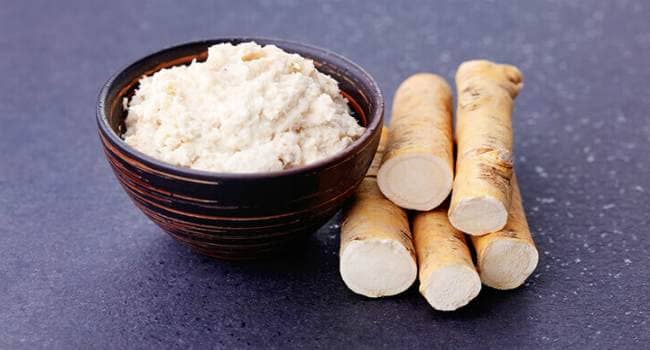
Among all the known spices and seasonings, horseradish seasoning is the most popular in the domestic market. The benefits of horseradish for the body lie not only in its pronounced taste and aroma, which improve the taste of the dish, but also in its useful and medicinal properties. This plant contains many beneficial substances, including vitamins, minerals and antioxidants, which have a beneficial effect on the entire human body.
Horseradish description
Such a familiar plant, which grows in almost all garden plots, has the official Latin name Armoracia and belongs to the cruciferous family. The closest relatives of horseradish are mustard and cabbage. Although some biologists consider legumes and cereals to be the predecessors of its appearance.
Horseradish grows throughout the European continent, with the exception of permafrost regions of the Far North. On the territory of Russia, the main areas of its growth are the southeast of Russia, Siberia, the Caucasus, the Far East, Europe, and Central Asia.
The plant is planted with rhizomes, choosing moist soils and shaded places. During the growth period, horseradish must be watered abundantly.
This perennial plant can grow up to 1.5 meters in height. Horseradish stem is erect and hollow, branching upwards. The leaves are large, oblong, carved at the edges. Horseradish blooms with white flowers from May to June. The fruits never ripen, are pod-pods with 4 seeds inside and are formed at the end of the summer period.
Horseradish is a winter-hardy plant and quite calmly survives cold frosty winters, remaining in the ground and releasing shoots in early spring. If the gardener decides to dig up the horseradish roots, then it is better to do this in October, after the large leaves have completely turned yellow and wither.
Horseradish composition
Horseradish root is the owner of many beneficial chemical constituents. Horseradish leaves and root contain:
- Protein fractions;
- Fats;
- Carbohydrates;
- Dietary fiber (fiber);
- Starch;
- Substances are nitrogenous;
- Essential oil (mustard oil, which adds pungency);
- Natural resins;
- Protein amino acid lysozyme;
- Glucosides (most of all sinigrin);
- Myrosin (an enzyme necessary for digestion);
- Phytoncides (natural antibiotics);
- Isothiocyanates;
- Ascorbic acid (antioxidant vitamin C, which is 5 times more in this product than in any citrus fruit);
- Retinol (or vitamin A);
- Carotenoids, in particular beta-carotene;
- B vitamins (folic and pantothenic acid, niacin, riboflavin, thiamine, pyridoxine);
- Minerals in the form of sodium, potassium, calcium, copper, iron, sulfur, phosphorus, magnesium, manganese and zinc.
The total calorie content of 100 grams of the product is 48–56 kilocalories.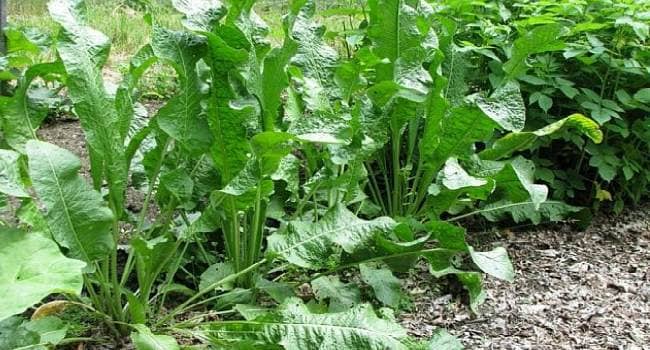
Horseradish benefits for the body
Due to the presence of many useful chemical components of horseradish, it belongs to medicinal plants that can cope with many diseases. The benefits of horseradish for the body are great. He:
- Increases and strengthens the immune system;
- Stimulates the production of white blood cells;
- Prevents cell mutation;
- Prevents the development of cancer;
- Reduces the risk of lung carcinoma (with the factor of smoking);
- Activates the activity of the stomach with reduced secretion of gastric juice;
- Improves intestinal motility;
- Stimulates appetite;
- Prevents constipation by improving the functioning of the intestinal tract;
- Treats diseases of the urinary tract;
- Has a diuretic effect;
- Helps to cope with infectious diseases of the respiratory system;
- Maintains normal blood pressure with hypotension;
- Serves as the prevention of stroke and heart attack (you need to eat only in small quantities);
- Reduces blood cholesterol levels;
- Saturates the heart muscle with potassium;
- Stabilizes the nervous system.
The health benefits of horseradish
Traditional healers have been using horseradish for the treatment of many diseases for a long time. Therefore, even today, some grandmothers and mothers do not abandon old recipes, where horseradish is one of the ingredients:
- Chopped horseradish (root) mixed with honey helps with cough;
- Horseradish tincture increases libido and erection duration in men;
- Horseradish leaves are often applied to sore joints (they have an analgesic effect);
- Small doses of horseradish are shown as a general tonic;
- Poultices help cope with frostbite;
- Horseradish with lactic acid improves the general condition of people with diabetes;
- Root pulp in tandem with honey also helps with urticaria and seborrhea;
- The root juice is recommended for gargling the throat and mouth to kill bacteria and relieve toothache (diluted with water beforehand);
- Horseradish partially helps with headaches, improving blood flow through the vessels;
- In case of anemia, the use of horseradish helps in the processes of hematopoiesis.
The use of horseradish in cooking
Horseradish fell in love in cooking due to its spicy-pungent taste. Therefore, modern chefs use such a seasoning for meat and fish dishes, stewed vegetables. Horseradish is added to sauces, salads, to appetizers.
Horseradish leaves are used as an independent product, which have become an integral ingredient in almost any pickles and preserves.
Chopped horseradish root goes well in kidney sausages and herring marinades.
Of course, the pungency that horseradish has is not to everyone’s liking. To reduce the severity of the cook, it is recommended to add fatty non-acidic sour cream to it.
How to clean horseradish
Before preparing horseradish as a seasoning or for medicinal purposes, its root must be peeled. Young roots do not require much effort and are easily cleaned as a result of using a metal or ordinary sponge with a hard side for washing dishes (you just have to rub them with it).
But more mature roots require more effort. To clear them you need to:
- Soak root vegetables in cold water for a day;
- Do not put in the refrigerator for a long time (that is, freeze a little);
- Then cut off the ends on both sides;
- Use a thin vegetable knife to scrape off the skin (similar to peeling carrots).
Those who are not afraid of tears can simply peel the skin with a knife.
Horseradish table how to cook at home
The table horseradish category includes already cooked chopped horseradish root. Many people buy this seasoning in the store, but some housewives prefer to cook it themselves at home. Indeed, in a store product there may be components that are not needed at all in it: preservatives, flavor enhancers, and so on. And the taste of the finished seasoning is not always satisfactory.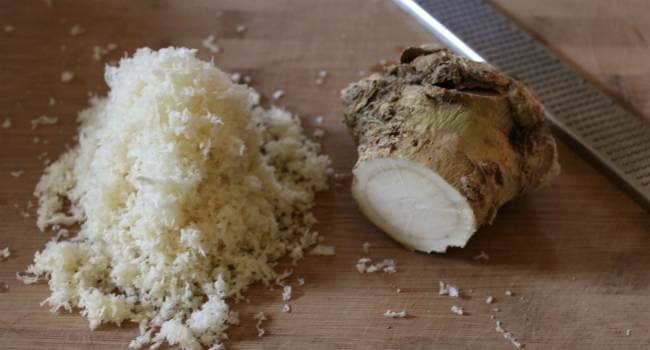
To make table horseradish at home, the roots must first be chopped up. Previously, they had to be rubbed on a fine grater, which was not very convenient. Each housewife knows how many tears have to “shed” while you rub one root. At the moment, there are several ways to grind the root:
- The peeled roots are scrolled in a meat grinder, closing the outlet with a plastic bag (secure the bag with an elastic band). Thus, horseradish goes directly into the bag, without causing irritation to the mucous membranes of the eyes and does not fill the apartment (house) with burning aromas.
- The blender also becomes an assistant in the preparation of your favorite spicy dish.
Chopped horseradish does not need to be sprinkled with beetroot juice to add appetizing color and to protect it from oxidation. Lemon juice and vinegar do this well.
It is also advisable to add a little salt and sugar (literally half a teaspoon each), a tablespoon of filtered or boiled water. Mix well and refrigerate in a hermetically sealed glass jar. After three hours, the seasoning is ready.
How to choose horseradish
To make a delicious seasoning, you need to choose good succulent horseradish roots. Therefore, before buying, first of all, you need to pay attention to the following:
- The roots must be clean;
- The absence of damage, stains and various defects on them;
- Elastic consistency;
- Lack of visible dryness;
- The length and width of the root (horseradish is considered the most delicious, not exceeding 25 cm in length and 3 cm in width).
How to store horseradish
Today, not only the roots themselves are often harvested for the winter, but also their upper ground part (that is, leaves). The leaves must be thoroughly rinsed and dried in the shade. After that, they are finely crushed and poured into glass jars, closing with a tight lid.
Fresh horseradish root is usually stored in a cool cellar or basement, sprinkled with sand or peat. Anyone who has a greenhouse can dig roots in it for the winter.
You can wrap the horseradish peeled from the earth in plastic wrap and put in the refrigerator. The shelf life with this method is 3-4 weeks.
Some people store horseradish roots in the freezer. In this way, it can be stored without losing valuable nutritional and taste qualities for six months.
Before laying in the freezer, the prepared roots are crushed and placed in small bags. It is allowed to finely chop the roots.
Some housewives rub the root on a coarse grater, dry it in the oven, and then, grind it in a coffee grinder to a powdery state, add it to a variety of cooked dishes. But even in this case, the grated roots should be placed in a hermetically sealed container. True, in this state, the root crop loses all its useful qualities in just a week, since the essential oils quickly evaporate. Namely, they give most of the useful and healing properties.
Potential harm
As a pungent and spicy product, horseradish can be not only beneficial, but also harmful in some cases.
According to experts, the consumption of horseradish is contraindicated:
- With inflammatory processes of the gastrointestinal tract, including diseases of the pancreas;
- People with problems in the functioning of the liver (the organ does not tolerate such severity);
- Pregnant women (they are generally not advised to consume spicy foods);
- With hypertension (horseradish provokes an increase in indicators);
- People with sensitive mucous membranes in the nose and throat (essential oils irritate the receptors).
There are many proverbs and sayings about horseradish among the people. Here is just one of these: “Horseradish and radish, onions and cabbage dashing will not be allowed.” Folk wisdom is formed from the experience accumulated over the years. Do not exclude this product, albeit not entirely pleasant to the taste, from your diet and it will certainly thank you with health.
Why horseradish is useful learn more from the video

What is sweeter than horseradish or radish? The answer in this video


