


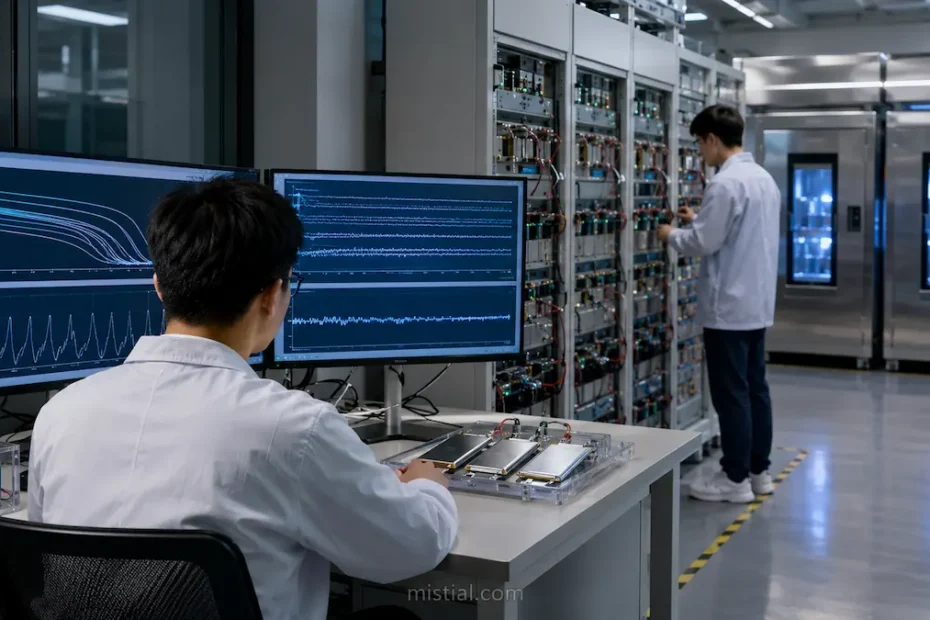
When battery researchers evaluate a new testing system, the first comparison usually starts with specifications.
Voltage accuracy, current range, channel count and sampling frequency are all important. Yet experienced engineers know that a battery cycler cannot be judged by numbers alone.
The real question is much simpler: can the system continue producing trustworthy data after months of continuous testing?
Battery development projects rarely finish in a few days. A cycle-life experiment may run for several months. Material screening programs often generate millions of data points. In these situations, stability becomes more valuable than impressive specifications on a product brochure.
This is one reason many laboratories spend as much time evaluating the testing platform as they do reviewing the specification sheet.
The Neware Battery Tester is used in applications ranging from lithium-ion material research to EV battery development and energy-storage testing. The platform combines precision current and voltage control with software tools that help researchers manage large amounts of experimental data.
For many engineers, repeatability is the first priority.
A promising battery material should deliver similar results when tested under identical conditions. If measurements vary significantly from one test to another, it becomes difficult to determine whether performance changes are caused by the battery itself or by the testing environment.
Temperature control is a good example.
A small temperature variation can affect capacity retention, internal resistance and charging behavior. This is why advanced laboratories increasingly combine battery cyclers with environmental chambers rather than treating temperature management as a separate process.
In recent years, researchers have also started paying closer attention to measurement resolution, especially when studying battery degradation and fast transient behavior.
Modern battery systems are expected to deliver higher energy density, faster charging speeds and longer cycle life. Understanding how these improvements affect electrochemical behavior often requires capturing very small changes in voltage and current over long testing periods.
Pulse testing, DCIR analysis and degradation studies all depend on measurement consistency. In many cases, reliable low-current measurements are more valuable than simply having access to a wider operating range.
Hardware often receives most of the attention during equipment selection, but anyone who has worked on long-term battery projects knows that software eventually becomes just as important.
Large-scale testing programs generate enormous amounts of information. Engineers need efficient tools for cycle-life analysis, capacity retention tracking, dQ/dV evaluation and long-term data management. Without practical software support, even highly accurate hardware can become difficult to use efficiently.
This is one reason battery laboratories often evaluate not only the specifications of a tester, but also the stability of the testing platform, data management system and long-term technical support. Companies such as Neware BTS have invested heavily in these areas because they directly influence the quality of research results.
For research teams looking for a battery cycler manufacturer in China, the most important specification may not appear on a product page.
In many laboratories, the real test of a battery cycler is not what happens during the first week of operation. It is whether researchers still trust the data six months later.
