


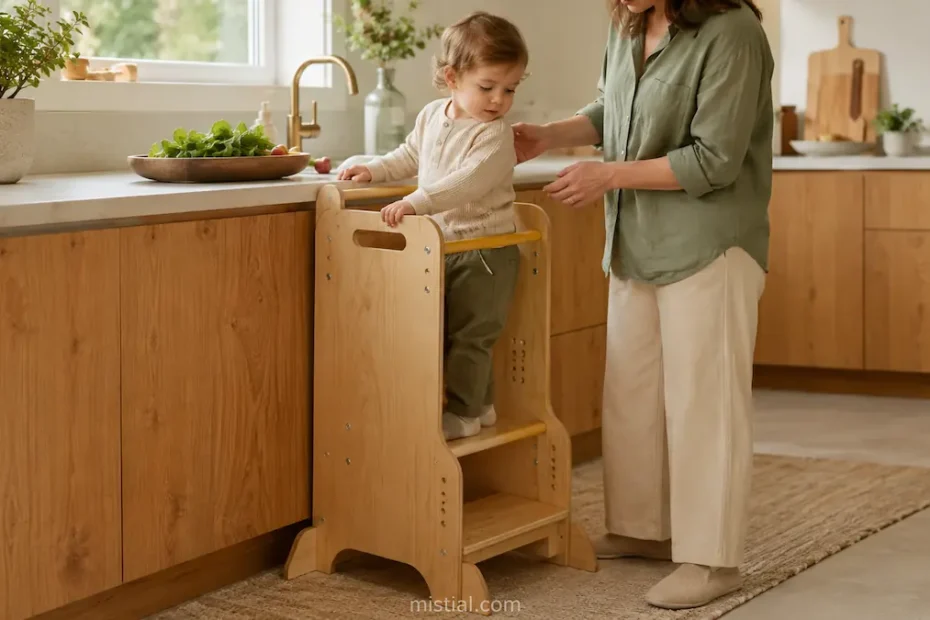
A learning tower can look perfectly stable in a product photo. The real test starts when a toddler climbs up, turns around, leans toward the counter and wants to get down again five minutes later.
That is why I would look at the structure before looking at colour options.
Wonfulity’s Toddler Learning Tower is designed to bring children up to counter height for everyday activities such as washing hands or helping with simple kitchen tasks. The same unit can also convert into a small table-and-chair setup with a whiteboard surface.
For a home buyer, that saves space. For a wholesaler or children’s furniture brand, it creates another question: does the conversion still feel straightforward after the product has been assembled, moved and used repeatedly?
That is worth testing with an actual sample.
I would open and convert the unit several times rather than checking it once in a showroom. Look at the joints, moving points and places where fingers naturally land. If the product will be sold flat-packed, assembly matters too. A design may be strong at the factory and still create complaints if customers struggle to understand the hardware or instructions.
The standing height deserves attention as well.
“Suitable for toddlers” is too broad for a purchase specification. Ask for the platform height, overall dimensions and intended age or size range, then compare those figures with the markets where the product will be sold.
The whiteboard is useful, but I would treat it as a secondary function. The tower still has to work comfortably as a standing platform first.
For B2B orders, finish consistency matters just as much as the prototype. Check edge sanding, surface coating and colour across several samples. Children touch every part of this type of furniture, including areas an adult might never notice.
Across its custom wooden product service, Wonfulity lists options for materials, colours, sizes and functional design, while its Custom Learning Towers collection includes convertible, foldable and adjustable models.
The wider Wonfulity website positions the company as a custom wooden products manufacturer serving B2B brands and wholesalers, with children’s furniture, Montessori products and wooden toys among its main categories.
For a bulk order, I would approve the structure, hardware, finish and assembly process across several samples before production starts.
For a retailer or private-label buyer, sample testing should reproduce ordinary movement rather than only checking a stationary load. Assemble the tower with the supplied instructions, record the time and tools required, and note whether holes, fasteners and panels align without forcing. Place it on several common floor surfaces and observe rocking, sliding and clearance around the platform. Check every reachable edge, corner, gap, hinge and locking point, including the product’s converted table-and-chair configuration. Repeatedly change the configuration to see whether hardware loosens or painted surfaces rub. Packaging should protect long edges and small components, while labels and instructions should remain easy for the final customer to find. Buyers also need verified age, size and load guidance for the intended market, plus documentation for applicable furniture and children’s product requirements. A strong sample review combines measurements, stability, finish quality, assembly experience and realistic supervised-use scenarios before a larger order is approved.
