


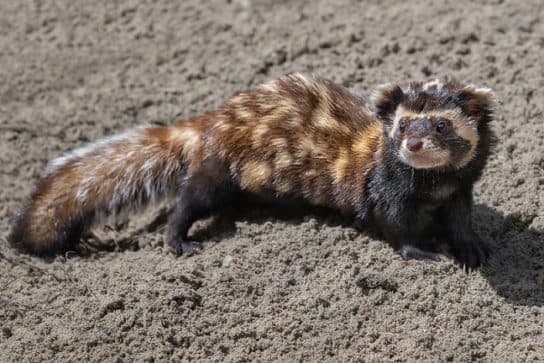
Peregusna belongs to mammals, is a representative of mustelids. The closest relatives of this animal are the weasel and the steppe ferret.
Appearance and description
Peregusna is a small animal. The animal has an external resemblance to the steppe ferret. The length of the body of the animal is 29-38 cm, moreover, the length of the tail is 15-22 cm. The weight of the mammal is in the range of 350-700 g. Sexual dimorphism is not observed in this species, females and males weigh the same.
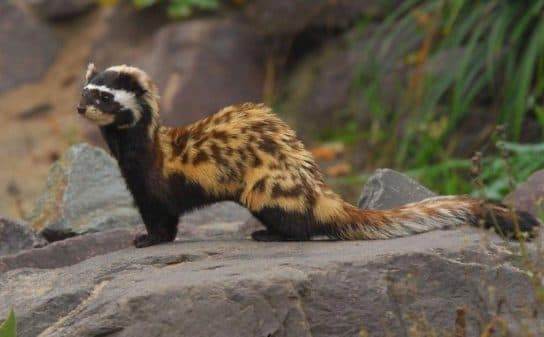
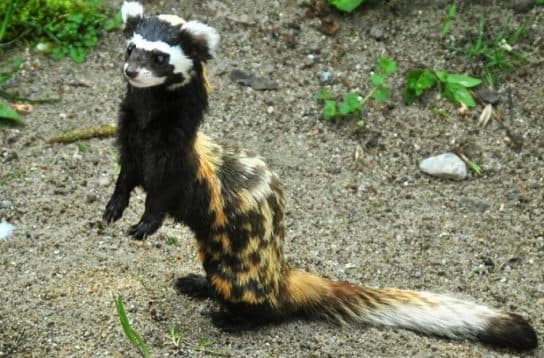
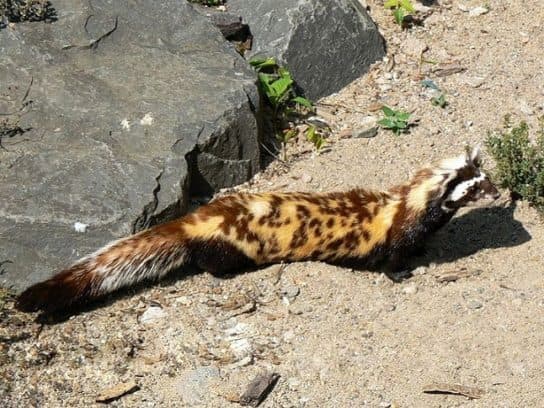
The dressing has an elongated body, a small head and rather short legs. The fur of the animal is not very thick, the animal usually looks disheveled, this is more pronounced when it leaves the burrow after a long sleep. The color of the animal is unusual, which includes black and yellow spots. The upper limbs and abdomen are brown, with yellow stripes and “blotches” visible on them. The lower part of the body is colored black. The muzzle of the animal is black and white, the skin around the mouth is predominantly white. The animal has a band that runs from the ears straight to the eyes. The tail of the mammal has a black tassel.
Bandage habitat
Dressings can be found in the Russian Federation: in the Saratov and Orenburg, Rostov and Samara regions. The animal also lives on the right bank of the river. Volga. The dressing also lives in the Altai steppes, near the banks of the tributaries of the Irtysh, in the Tyva Republic. The predator also inhabits Europe and Asia, from the Balkan Peninsula to northwest China.
Pereguzna inhabits both steppes and hills. The animal prefers an area with dense vegetation. The mammal is unevenly distributed throughout the habitat, at the moment the distribution map forms a mosaic. Interestingly, the animal instantly leaves those places that are beginning to be turned into farmland. Bandages are also found on mountain plateaus, in the mountains, but not higher than 3000 m above the water level. At the moment, animals settle next to humans: in parks and vineyards, on abandoned lands that are located around cities.
Lifestyle
Dressings are spent almost all day in a burrow. They can either dig it up on their own or take it away from voles and ground squirrels or hamsters. Animals hunt at night, in many ways their habits are similar to those of ferrets. Animals communicate with relatives only during the mating season, individuals live alone.
Pereguzna orients itself on the terrain using the sense of smell; per day the animal can cover about 600 m in search of ground squirrels and voles with hamsters. The predator looks for prey in underground passages and on land. On the surface, an animal in pursuit of prey can make 60-centimeter jumps. If there is enough food nearby, dressings are sedentary. There is information that overgrowers sometimes attack groups of gerbils, cooperating with foxes. Those individuals who are trying to escape by flight fall to the foxes, and others who are trying to get out with the help of underground passages – to the bandages.
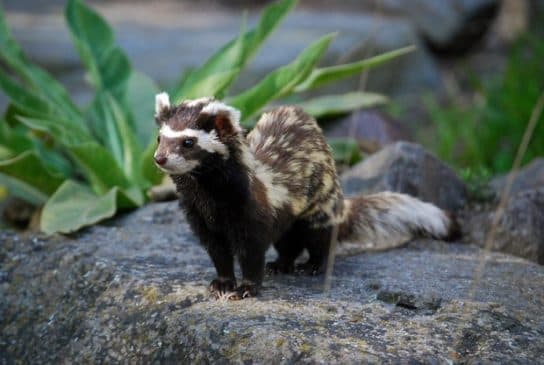
Representatives of the weasel family often leave paired oblique tracks, which are called two-bead. When exploring the area, the individual stops, raises its head and begins to look around. If the animal senses danger, it becomes a “post”, and the viewing angle increases. If the alarm was false, the animal moves on, and if it is not, the overgrowth climbs a tree or hides underground. In the case when there is no time for this, the predator takes a threatening pose, raises its body and throws its tail over its back. The animal builds a grin and begins to growl. If the hunter is not intimidated by such behavior, the dressing itself starts a fight, and an unpleasant-smelling secret sprinkles from the anus of the animal. These secretions are similar to those of a skunk.
Interesting Facts
- Peregrine’s vocalization is limited. The animal can shrill, grunt and squeal in case of danger. The mammal also often growls when it is angry about something.
- The favorite fruits of the dressings are melon and watermelon.
- Sometimes animals hunt underground, in the passages of rodents, where they can settle.
- The territory of individuals can overlap, but there is no struggle for places.
- Overweight females reach sexual maturity as early as 3 months, and males only a year.
- When playing with humans, females often assume a defensive posture. They begin to jump on their feet forward, backward and in all directions.
- In captivity, dressings live for about 9 years.
- The name of the species in Latin – “vormela” means “little worm”.
- Peregusna leaves no claw marks on solid ground.
What eats
Peregusna feeds on gerbils, voles, ground squirrels and hamsters. Sometimes the diet of animals includes jerboas and birds, snakes and frogs, representatives of invertebrates. If there is an opportunity to steal bird eggs, eat berries and fruits of trees, animals use it. In captivity, dressings are also fed with dairy products: cheese and cottage cheese, sometimes they are fed with meat.
Reproduction
The breeding season begins in June and ends in August. The male attracts the female’s attention by cooing. Mating does not last long; after the process, the female is immediately removed. The mother-to-be chooses a partner based on his closeness. Pregnancy at Peregus lasts about 11 months.
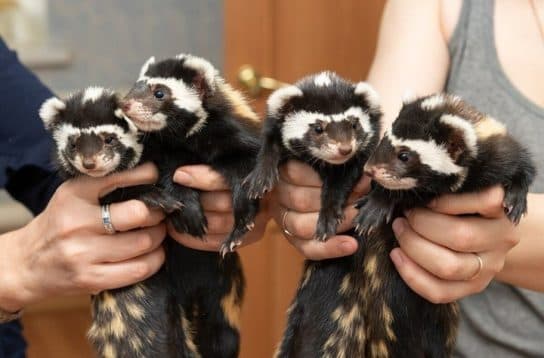
The embryo has a developmental delay. Usually 1-8 dressings are born, only four of them grow quite quickly. At birth, the offspring is absolutely naked, there are thin white hairs on the bodies. Baby bandages are born blind, their auditory canals are closed for the first time after birth. The average weight of the baby is 5 g, the body length is about 5-7 cm. There is a pattern on the baby’s skin that is similar to the color of an adult. There are formed claws on the paws of babies. The eyes of babies erupt only on the 40th day, the mother stops feeding the children with milk after a month and a half. In the second month of life, the female sends the children into adulthood, and after three more the cubs already have their own family.
Subspecies of dressings
There are several subspecies of these mustelids: Vormela peregusna koshewnikowi, negans, Semirechenskaya and South Russian peregusna, Syrian peregusna.
Red Book
In the Russian Federation, there are only two subspecies of peregusny: Semirechensky and South Russian. Populations of subspecies are endangered, they are listed in the Red Book of Russia. Poaching is one of the main reasons for the decline. The number of the species is also falling due to pollution of animal habitats, which is why they are forced to look for less favorable places.
Another reason for the decline in numbers is the extermination of rodents. The decline in the population is also caused by the plowing of the steppes, overgrazing of livestock. Over the past 2 centuries, the habitat boundary has decreased by 600 km from north to south and by 700 km from west to east. Populations located at the boundaries of the habitat are especially affected.
The number of dressings is monitored in the Dagestan and Stepno-Saratov nature reserves; there are also small experimental groups on the banks of the reservoir in Tsimlyansk.
Difference between dressing and steppe ferret
The dressing has a much smaller muzzle than the ferret. This mustelid has small short ears covered with thick fur. Peregusna is also brighter in color. Despite the external similarity, animals never mate, because the dressing is quite selective in this matter.
