


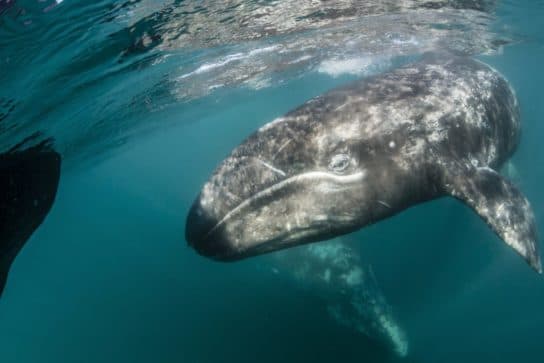
The gray whale is a marine mammal that belongs to the suborder “baleen whales”. In the family “gray whales”, this species exists in the singular. The gray whale is also called the Californian. It prefers places located close to the coast and usually reproduces in shallow waters.
Description
The gray whale has a movable head, large pelvic bones, rather large nostrils, and a long neck. The belly of the gray whale is smooth, with deep grooves (2-4) near the neck, diverging back at a slight angle. The furrows are 5 centimeters deep and two meters long. The fins located in the chest are four-toed, wide and short.
The head is compressed at the sides and is four times smaller than the body of a whale. A very large mouth with strong and massive jaws is located horizontally. They are symmetrical and have barely noticeable hairs up to 3 cm long (vibrissae). There are about 250 of them in total.
The whisker has yellowish or white plates up to 30 centimeters high. The plate fringe is completely inelastic, thick and rough. Each half of the jaw contains 130 to 182 plates.

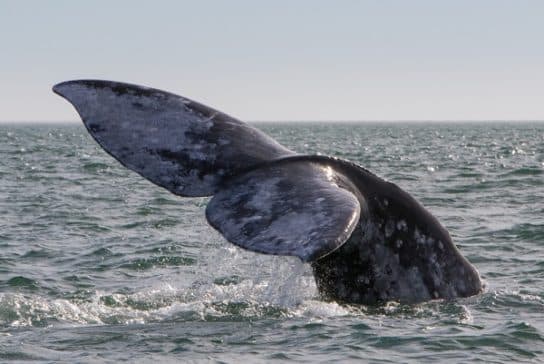
The gray whale has no fin on its back. Instead, there is a small hump, followed by tubercles, located one after another towards the tail. There are from 6 to 14 of these tubercles. The tail is also provided with small bulges on each side. The caudal fin has a deep notch between the lobes.
The body of the whale is gray-brown in color with spots of different shades, close to gray. Large numbers of barnacles are attached to the body of a gray whale.
Dimensions and weight
Adult gray whales have the following body lengths:
- Females 12-15 meters;
- males are 11-14.6 meters high.
The mass of whales ranges from 15 to 35 tons. Females are larger in size and weight than males. They weigh between 29 and 34 tons. This is obviously due to the fact that they spend a lot of physical energy on bearing cubs and feeding them.

Where dwell
Gray whales are currently observed in two herds: in the Chukchi-Californian and Okhotsk-Korean regions. The Chukchi-Californian herd fills the Gulf of California in winter and lives in the Bering and Chukchi Seas in summer. It has 26,000 animals.
The second herd overwinters and breeds near Korea and South Japan, and in summer migrates to the Sea of Okhotsk near Sakhalin.
What do they eat
The diet of gray whales is varied, there are about 70 different species of animals related to invertebrates, among them:
- bottom fish;
- small crustaceans;
- bivalve molluscs;
- annelid worms;
- planktonic organisms;
- amphipods;
- sipunculids;
- sponges.
An adult whale needs 500-1200 kilograms of food per day. To do this, he has to filter out tens of tons of silty soil and sand. The gray whale gets food at a shallow depth (5-100 meters). At the bottom, it lies on the side of the body and sucks in silt, sand and prey at the same time. Then it filters objects for food, swallows them, comes up to swallow air and goes back to the bottom for a portion of food.
Whales also feed on various plankton found in the water column.
Migration of gray whales
Gray whales hold the record for the distances they cover during migrations. Each year they sail more than 20,000 kilometers from the ice of the Arctic to the subtropical seas and back.
The speed at which whales migrate can be about ten kilometers per hour. Typically, gray whales spend three months to overcome the migratory route. Throughout this period, they live off the fat accumulated in the subcutaneous layer and lose a third of their weight.

Gray whales swim, without stopping, but after every three to four minutes, they emerge and release fountains of water. The fountains are bifurcated, short and wide.
Whales sometimes migrate alone, more often in pairs or unite in groups. The maximum number of animals in a group can be up to eighteen individuals. The group is always led by females who have recently become pregnant.
Reproduction
Gray whale puberty occurs at the age of eight years. At this time, they grow to a length of about 12 meters. Mating games and the season of conception usually take place in December-March. The female bears the cub for almost 13 months. The female gives birth to one cub at intervals of two years.
Newborn babies weigh about 800 kilograms, and their body length can reach 5.5 meters. After birth, the whale is still clumsy and the mother has to push it to the surface of the water to swallow air.

The breastfeeding period lasts approximately seven months. The milk of females has a fat content of more than 50%. While feeding the baby, the female gray whale behaves very aggressively. She has a highly developed maternal instinct, so she can attack the enemy before he reaches the cub.
By the age of eight months, the baby grows up, and its length reaches seven meters, and by the age of two, the cub already has a body length of 9 meters.
Whales live in lagoons for three months. This time is enough for young animals to accumulate subcutaneous fat, which is necessary for the migration period to the northern waters.
Enemies
The main enemy of the gray whale in nature is the killer whale. It usually attacks gray whale cubs. Females and adult whales try to protect babies from the predator with their own bodies and swim to the coastal shallow water zone with algae. Killer whales no longer swim there.
Killer whale vs gray whale – video
Conservation status
The Okhotsk-Korean gray whale population numbered around 3,000 by the beginning of the 20th century. In the middle of the same century, it was considered extinct.
But in the coastal zone of Sakhalin Island, in the early eighties, 20 animals appeared. At present, the number of individuals is within 150. This population has been assigned the status of “threatened with extinction”.
The gray whale of this population is included in the lists:
- International Red Book;
- The Red Book of the Russian Federation;
- The Red Book of Kamchatka;
- International Union for Conservation of Nature.
Limited whale hunting is permitted in Chukotka. For her, only the use of hand harpoons is allowed, and meat and other material is prohibited for sale.
Today the gray whale is the smallest. Since 1946, the International Whaling Commission has banned the commercial fishing of gray whales.
Interesting Facts
- Among gray whales, there are “right-handers” and “left-handers”. This can be determined by the presence of abrasions on their faces. Whichever side there are more of them, the one they dig, getting their own food. It turns out that there are much more “right-handers”.
- Each gray whale has its own individual pattern on its tail, just as there are individual patterns on human fingers.
- The gray whale swims a distance of 20,000 kilometers annually.
- The gray whale is able to survive for a long time without an aquatic environment. At low tide, it lies on one side, usually on the right, and feeds on invertebrates living in the coastal silt. After the tide occurs, the whale swims freely into the sea.
- When the gray whale swims during its migration, for orientation, it puts its head vertically out of the aquatic environment and looks around to determine its location.
