


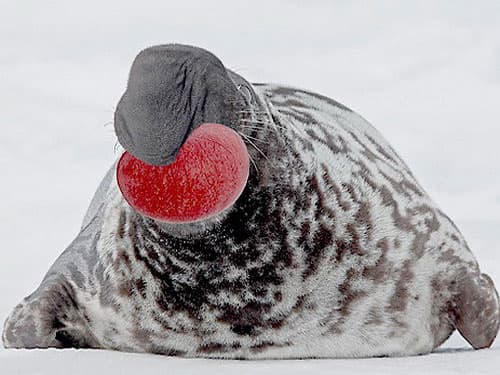
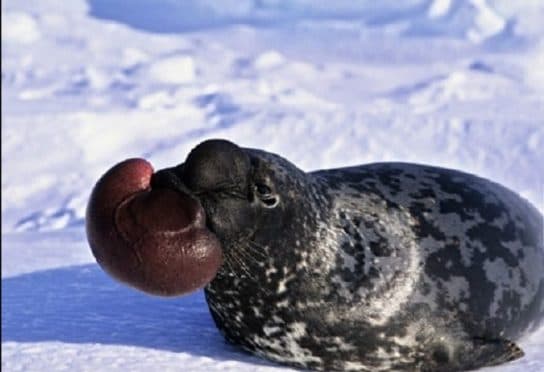
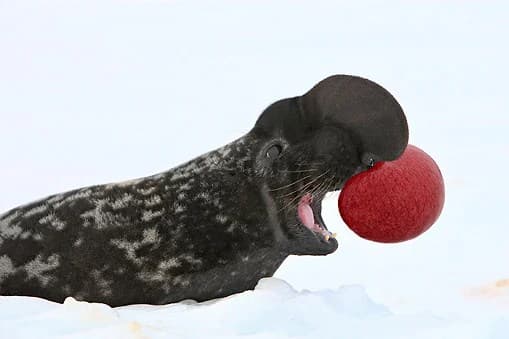
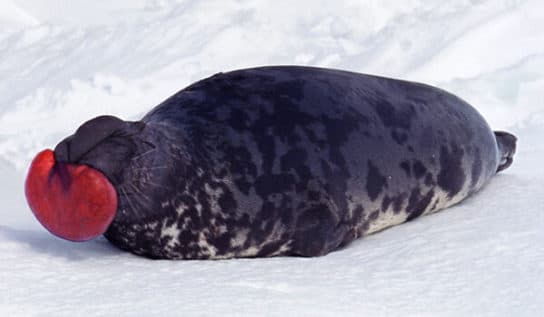
This amazing seal got its unusual name due to its unique appearance – and all thanks to the leathery growth on the face of the representatives of its strong half. Such a formation, sometimes simply called a bang or crest, is nothing more than a nostril that has grown to an unimaginable size – after all, it is located just at eye level.
When the animal is calm, folds simply and naturally hang down. But when the male gets angry – the nasal openings are closed – and this crest is filled with air from the lungs. Moreover, the male is able to inflate him at his own whim – for the sake of fun and training.
Description
Khokhlachi are a completely unique species of seals. It is the representatives of this species that are the owners of the largest nostrils in the family. The hooded animals have a short skull shaped like a wide muzzle. The third part of the entire nasal bone extends beyond the boundaries of the upper jaw, and the palate protrudes from behind much further than other parts of the body. Even his teeth are unique – the crest is equipped with two upper incisors and one lower, and the general dentition is rather narrow.
Khokhlach also received the nickname of the blue seal – after all, his young are equipped with a very interesting fur coat: silver on the dorsal side and pale blue under the belly.
Appearance
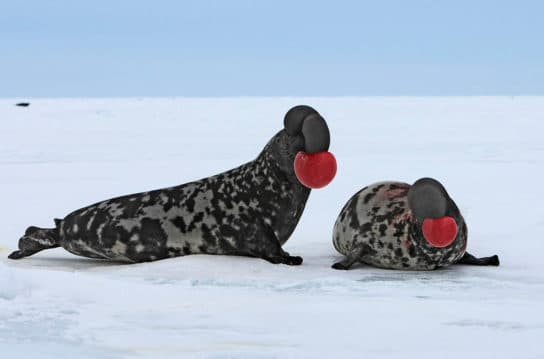
In adult hooded animals, the fur is blue-gray with dark spots scattered over the body with a black muzzle. In these animals, sexual dimorphism is expressed – the males of this species reach a length of up to three meters, and the females are slightly smaller – 2.2 meters. Moreover, the males are an order of magnitude larger – they weigh up to 300 kilograms, while the females are almost two times smaller. Of course, males can also be distinguished by the nasal sac on the front of the head.
This sac is absent in males until the age of four years – but then males play with pleasure, inflating this bright red bag from their nostrils to attract females or in case of aggression.
Where dwells
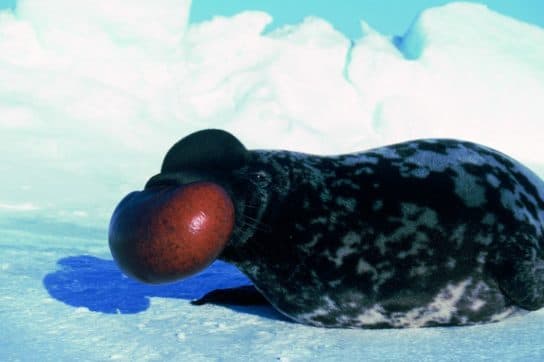
Hooded cats are usually found in northern latitudes – along the east coast of America, in the northern part of the Atlantic. You can also find them on the western tip of Europe – just along the coast of Scandinavia. Their habitat also affects Iceland and part of Greenland – and sometimes (although extremely rare) they can be found in Siberia. Hooded hooters breed on ice – and distinguish several main habitual breeding areas: St. Lawrence Bay, Newfoundland, the center of Davis Strait and Grendandia (near Jan Mayen Island).
What eats
Hooded seals, like any seals, prefer to eat a wide variety of marine prey – and, first of all, this is fish: herring, cod, flounder and other species. They also do not neglect other marine life – shrimps and octopuses, squid (they prefer this type of food in winter, switching to fish in summer). First, juvenile seals learn to hunt in shallow water – mainly squid and other crustaceans.
During the flowering period of phytoplankton and other Arctic algae, which fish and other herbivores feed on, their energy (we are talking about fatty acids) is transferred to seals, where it is stored in adipose tissue and actively participates in the metabolism of representatives of this species.
Natural enemies
Naturally, such a huge animal has practically no natural enemies in nature – and the most important reason for their extermination has always been people. It is people who have been hunting these seals on a huge scale for more than a century and a half – for example, in forty years (from 1820 to 1860) more than half a million seals were destroyed. At first, the reason for such extermination was oil and seal fat, and then, starting from the middle of the twentieth century, they began to hunt for beautiful fur – it is four times more expensive for hooded seals than for other seals.
Among the natural enemies of the hooded whale are sharks, killer whales and polar bears. The purpose of hunting polar bears is usually the smaller harp and other species of seals, but during the breeding season bears do not neglect an excellent opportunity to profit from the hooded seals.
Scientists even suggest that the size of the population of these seals will decline in a rigid progression of about 4% per year – thus, in three generations, the decline will amount to 75%. And even if the reduction is reduced to 1%, then in three generations it will be 32% – and such indicators make it possible to qualify this species as vulnerable. After World War II, scientists feared the threat of extinction of this species from the face of the Earth.
Naturally, in recent years, unprecedented measures have been taken to conserve seals, which include international pacts, plans, catch quotas and many other ways that are more than hundreds of years old (starting from 1870). Moulting and breeding places of the hooded beetle are protected (since 1961) and a variety of quotas and restrictions have been established. This type of seal is included in the Red Book – and hunting for it has been banned for over 50 years.
Interesting Facts
Hooded seals are solitary animals – they have absolutely no competition both for territory and in terms of social hierarchy. Hooded seals, like many other seals, are a migratory species – and, interestingly, each year they strictly follow the adopted movement pattern, which completely repeats the pack ice drifting route, which allows the seal to stay close to it. So, in the summer, hooded people move to the coast of Greenland – to its southeastern coast and a point in the northeast. And after the seasonal molting, the animals disperse – and already more calmly drift to the north and south of the Atlantic during the entire autumn and winter period, gathering again in the spring at a single point.
These animals also have one interesting feature – when immersed in cold waters, hooded chicks are not susceptible to hypothermia – this is due to the fact that the trembling process can significantly increase the need for oxygen, which means – reduce the possible time spent in the water. On land, shivering from cold occurs – but it instantly stops or slows down significantly at the moment of immersion in water.
