


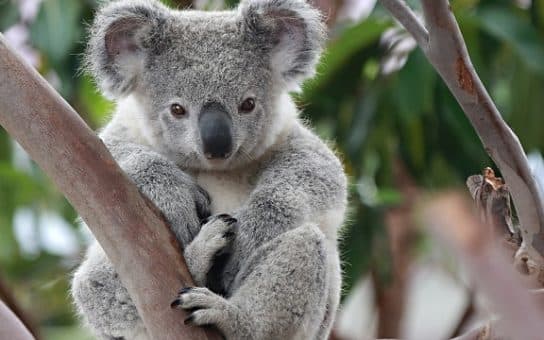
Koala is an absolutely adorable, extraordinary and unique animal.
What continent does the koala live on?
The koala marsupial bear is a symbol and endemic to Australia and, due to its rare beauty, lives in reserves and is listed in the Red Book. The bear resembles a plush toy that you never want to let go of. The adorable animal was discovered by Europeans in the 19th century and since then is considered the most popular on the entire planet.
General characteristics of the koala
Despite the fact that the koala is called the Australian bear, the animal has nothing in common with the formidable animals. Representatives of herbivores belong to the marsupial family. The appearance of the animal is quite unusual: thick and short hair of a gray or smoky shade, white abdomen, low weight (up to 14 kg) and body length of about 85 cm. The koala has poor eyesight due to small and dim eyes. This loss is fully compensated by excellent hearing and smell. The animals have large ears located at the edges of their heads and a flattened black nose.
Nature has made sure that koalas can easily eat grass, creating the ideal structure of the teeth for this process. A feature of bears is their front tenacious paws and long claws, which allow the animals to move freely and live in trees. The animals have interestingly developed limbs: the front ones have two biphalangeal thumbs and three standard ones (with three phalanges). The hind ones have one thumb and four regular toes (no nails). Koalas also have a small tail that is almost invisible under the coat.
Animal lifestyle and nutrition
Koalas are dark-loving animals that prefer to sleep on tree branches during the day. Marsupials are calm, phlegmatic, good-natured animals. Koalas love solitary, even reclusive life and connect only for the purpose of breeding. Each animal has its own separate territory, which is unacceptable to violate, otherwise an aggressive reaction may follow.
Koalas are vegetarian. They love to eat eucalyptus leaves, shoots and other plants. Many herbivores are not interested in these flora species, as they contain a small amount of protein and hydrocyanic acid. An adult animal can eat up to 1.1 kg of leaves per day. Koalas drink very little and for some, it is enough to enjoy the morning dew to quench their thirst.
Interesting facts about bears
Koalas are considered sedentary animals, which is explained by the low metabolic rate in the body. However, marsupials are capable of running and jumping superbly from one tree to another.
Many herbivores cannot eat eucalyptus, because it contains poisonous substances in destructive quantities. In the body of koalas, negative compounds are neutralized, and the bears feel great.

Koalas are peaceful animals. At the same time, they cannot boast of a safe life. Marsupial bears often get sick, including sinusitis, cystitis, cranial periostitis, and conjunctivitis. In many cities, special centers are equipped in which sick animals are treated.
Australian bears are stationary or eating almost all the time. They prefer to be alone, therefore they practically do not make sounds. However, if necessary, animals can scream and even growl.
When the animal is pressed against the tree, thermoregulation occurs. For example, in the heat, koalas climb on the acacia, as this is the coolest tree.
Mammals have unique patterns on their fingertips so that they can be identified.
Breeding koalas
Male marsupial bears have a forked penis, while females have two vaginas with a corresponding number of queens. Despite this, a koala usually gives birth to one cub.
The breeding season for bears starts in October and lasts until February. Females independently choose their partner. The selection criteria are influenced by the size of the male and the volume of his cry. In nature, there are significantly fewer males among koalas than females. Therefore, one male can have a relationship with three or five females.
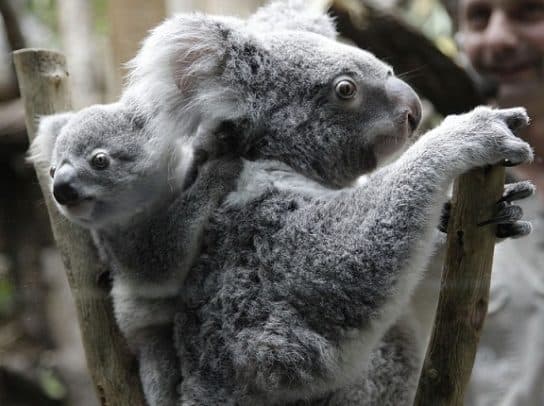
Koala bears a cub for 30 to 35 days. It is extremely rare that two teddy bears are born. An interesting fact is that a female can become pregnant only once every two years. At birth, koalas do not have hair and in the first days are under the full care of their mother (they drink breast milk and sit in a bag like a kangaroo). Over time, the cubs climb the mother’s scruff, clinging securely to the fur. By the end of the first year of life, young koalas are ready for independent existence, but for several more years they are near their mother. In the future, bears leave their home forever and go on a “free swimming”.
Koalas are amazing animals that can feel and experience pain like humans. They can cry loudly and hysterically, which is accompanied by tremors.
