


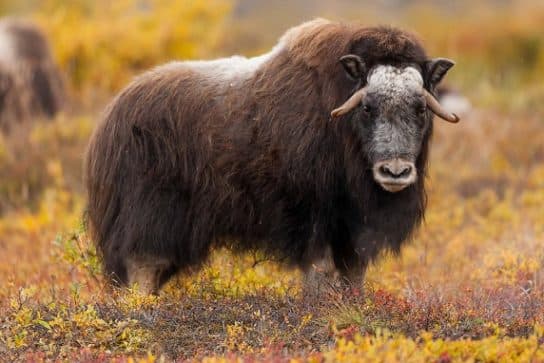
The musk ox is a whole genus of musk ox, belonging to the bovid family. For a long period, scientists could not determine the identity of this representative. Previously, the musk ox was a species of the bovine subfamily, but now it has been assigned to the goat subfamily.
Description of the species
The ancestors of this animal inhabited the territories of Central Asia, in particular, the Himalayas. Due to the change in climatic conditions, they moved to the region of Siberia, where they settled the entire North Eurasian region. Then they crossed the Bering Isthmus and ended up in America. After a sharp warming, the number of musk oxen sharply decreased. All the musk oxen of that time also died out, and only the reindeer remained.
Many consider the musk ox to be a hybrid animal of a sheep and a cow. However, it is not. Despite the fact that the appearance of this representative is similar to these two animals. Westerners are used to calling the musk ox a musk ox, but this name is not associated with a musky secret. Their name comes from the “musked” swamp. The closest related animal of the musk ox is the takin.

Appearance
The musk ox is a rather large animal, the growth of which reaches about one and a half meters, and the weight varies from 240 to 650 kilograms. The musk ox got its characteristic appearance in connection with evolution, when it was necessary to adapt to serious climate changes. Almost the entire body is covered with extremely thick and elongated fur, which acts as thermal insulation due to the giviot. Giviot is a dense undercoat that retains heat much better than sheep wool. The musk ox is a rather stocky animal that is endowed with a large head with a short neck. Due to the thick coat, it seems to be larger than its actual size. Also, the musk ox has acquired extremely dense muscles. The number of muscles in his body reaches about 20 percent of the total mass.
The facial area of the musk ox is covered with thick short hair. The ears have a pointed shape, which is not always visible against the background of the hairline. The limbs are well developed and covered with fur up to the hooves. A distinctive feature is also the difference in the size of the hooves: the hind ones are smaller than the front ones. The tail of the musk ox is shortened and hidden under the coat.
The musk ox has sickle horns on its head. In males, they are wide and wrinkled at the base of the forehead. As it grows, the horns become thinner and slightly drooped towards the eyes. The color of the horns is predominantly gray, but there are also beige or brown. The color darkens from the base.
The color of the musk ox’s coat is predominantly brown. The upper body region is predominantly dark in color, and the lower one is light. There is a small light spot in the center of the ridge. The color of the fur on the legs is whiter.
The coat of the musk ox reaches 15 centimeters in length. The structure of the coat contains about 8 different types of hair.
Sexual dimorphism
Sexual dimorphism is quite pronounced. Males and females differ not only in behavior, but also in anatomy. The weight of males reaches about 400 kilograms with an increase of up to one and a half meters. While females have a maximum height of 1.2 meters and weigh up to 240 kilograms.
The difference between the sexes lies in the appearance of the horns. Males are endowed with more massive and longer horns up to 73 centimeters long. Female horns are almost half the size of male horns. Also noteworthy is the fact that females have white fluff in the place where the horns grow.
The sex difference also lies in the time of puberty. The female becomes fertile at 2 years old, and if there is a sufficient amount of food, at 15 months, while males are not earlier than 2.5 – 3 years of age.
Where does the musk ox live?
The modern habitat of musk oxen is concentrated in the regions of North America, as well as in western and eastern Greenland. For some time, the animals existed perfectly in northern Alaska, but they stayed there only until 1865, since they were massively exterminated. They began to breed again in 1930.
They tried to breed musk oxen artificially in Iceland, Norway and Sweden. However, this attempt was unsuccessful. Recently, their re-acclimatization has been launched in Russia. About 8000 of these animals were found in the Taimyr tundra.
As a habitat, musk oxen prefer to live in flat and mountainous areas. Their habitat should be at least 200 square kilometers. This area is actively used by a nomadic herd in search of food.
Musk ox in Yamal
Musk oxen on Zavyalov Island
Nutrition
The musk ox is an absolutely herbivorous representative that was able to adapt to the scarcity of forage reserves in the Arctic. Summer in this region only lasts a couple of weeks. Musk oxen are forced to feed on vegetation located under a large thickness of snow cover.
Plants that make up the diet of musk oxen:
- shrub willows;
- lichens;
- moss;
- mytnik;
- meadow and foxtail;
- smoke.
In summer, animals actively store up nutrients, feeding on natural salt licks.

Lifestyle
Due to their thick fur, musk ox thrive in cold tundra conditions. The lifestyle of this animal is similar to that of sheep. They organize small groups of up to 10 individuals in the summer and up to 50 individuals in the winter. Autumn and summer groups are predominantly of the same sex. Some musk oxen prefer a hermitic lifestyle.

During the search for forage resources, the herd is led by the chosen leader or cow. They move slowly, only sometimes accelerating up to 40 kilometers per hour. The animals themselves, despite their large size, are excellent climbers. The nomadic period begins in September and lasts until May.
The musk ox spends the winter period in hibernation. During this time, they digest all the vegetation that they got from the thickness of the snow. With the onset of an arctic storm, musk oxen turn over with their backs to the wind. Frost is not dangerous for these animals. However, large snow cover can greatly affect the ability to obtain food.
Fight of musk oxen
Reproduction
The breeding season starts in July and ends in mid-October. Due to fluctuating climatic conditions, the rutting period may be shifted to autumn. Sexually mature females organize separate herds, which are then covered by one dominant leader. In small groups, subdominant bulls can take on this role. Many males fight for the chosen female. The fights are characterized by the display of the male threat to the opponent, in particular, tilting the head, roaring and butting. Only if no one leaves for a long time, then a serious fight begins. The bulls disperse to a distance of 50 meters and begin to chase each other towards a meeting, knocking off their foreheads. Some males may die in the field.

After the formation of a couple, the pregnancy period begins. It lasts about 8.5 months. One, less often two, cubs with a weight of up to 8 kilograms are born. After a couple of hours, the calf that appears begins to step after the female. Little musk oxen feed on their mother’s milk several times a day. Due to the high percentage of fat in milk, musk oxen can grow extremely quickly. By the age of two months, they weigh about 40 kilograms. Milk feeding ends at 4 months. In rare cases, it can take up to a year. At the age of 7 days, the young begin to taste mosses and rags. A month later, they feed on herbs in parallel with mother’s milk.
The female stays with her offspring throughout the year. In regions where there is a sufficient food supply for animals, offspring appears with an annual frequency.
