


Polar wolves (Latin Canis lupus tundrarum) represent the species of ordinary wolves. They belong to the canine family and the wolf genus. According to their external characteristics, they do not differ from representatives of the species of common gray wolves. Their characteristic color is determined by their habitat.
Appearance
Polar wolves are fairly large mammals. Their body size reaches about 180 meters in length with a height of 100 centimeters. Body weight ranges from 85 to 92 kilograms. Sometimes polar wolves can be quite large, but the number of such representatives is rather small.
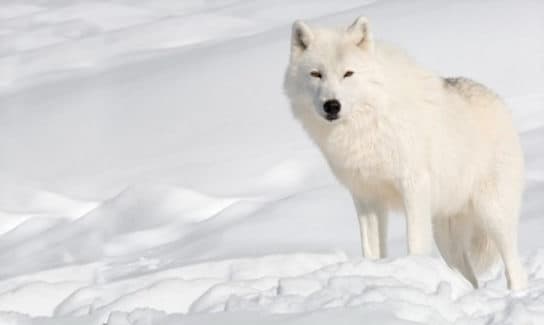
Sexual dimorphism is that females are 15 percent smaller than males. The distinctive fur of polar wolves is characterized by a strong density and white color, which has a reddish tint. The limbs are muscular and long. The tail is short, covered with thick and lush hair.
Habitat conditions
The habitat of polar wolves is concentrated on the territory of the Arctic tundra, with the exception of ice areas. These representatives are also found in dark polar areas. The animals have adapted to the harsh conditions of the Arctic, which is why they are able to withstand low temperature conditions for a long time, often starve and do not have access to sunlight.
At the moment, these predatory animals have inhabited the most barren areas of the earth. Since April, the temperature does not rise above – 30 degrees Celsius, and the entire territory is subject to the influence of strong and gusty winds. Vital activity in the Arctic is supported by an extremely small number of mammals.
Nutrition
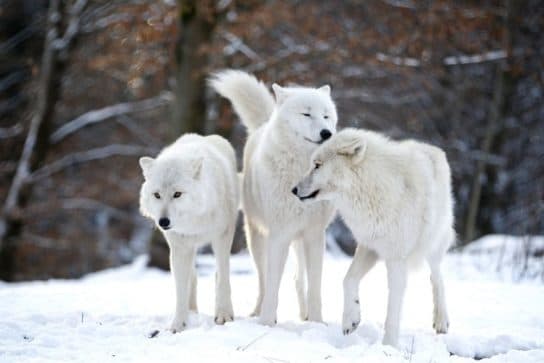
Since the Arctic is almost entirely open space, polar wolves can hide in order to unexpectedly grab their prey. Their main food is musk oxen and deer. Less often, small lemmings and polar hares are included in the diet of wolves. The hunt is conducted in flocks. If a herd of musk oxen runs next to the wolves, then they arrange a chase. During this time, the musk oxen have time to take up an all-round defense. Then the animals are forced to wait, because they will not be able to break through the barrage of horns and hooves.
Polar wolves can arrange races around the herd, as a result of which they, musk oxen, can change their position, breaking the circle. However, this tactic does not always work. If they managed to do this, then the musk ox becomes a fairly simple prey. Wolves go in pursuit of a single victim, and then seize it with joint efforts and knock it to the ground.
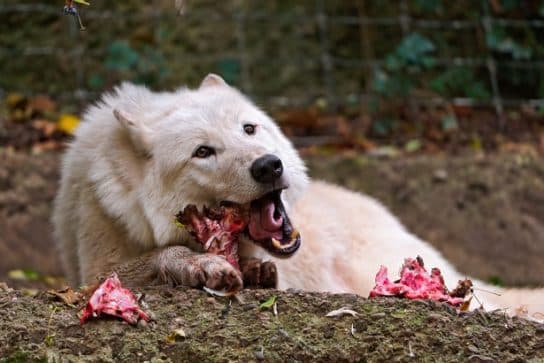
With the onset of winter, organized packs of polar wolves begin to look for places with a more favorable climate, where they can find their prey. They migrate south following the herds of reindeer. If the polar wolf did not have access to food for a long time, then it eats about 10 kilograms of meat. Carcasses are butchered with their powerful fangs, and the meat is swallowed almost immediately.
Breeding period
The breeding season starts in March. Pregnancy lasts about 63 days. An average of 4 cubs are born. The offspring is brought only by the female leader, who is elected among the other females of the flock. If another female becomes pregnant, then her droppings are immediately destroyed. This is due to the insufficient amount of food on their territory, which is why wolves cannot acquire large offspring.
After the end of the mating season, the female separates from the flock and searches for a safe refuge. Sometimes she equips it on her own, but most often she populates rock crevices. Cubs appear very weak with a weight of no more than 410 grams at birth.
At first, small polar wolves spend with a female. She feeds them with milk, and at the age of one month, they begin to feed on semi-digested meat, which the male regurgitates. While the female is busy looking after the wolf cubs, the male goes in search of food. If polar wolves are well fed, then they quickly get back on their feet. With the onset of summer, they join the pack of adult wolves. At 3 years old, animals become sexually mature.
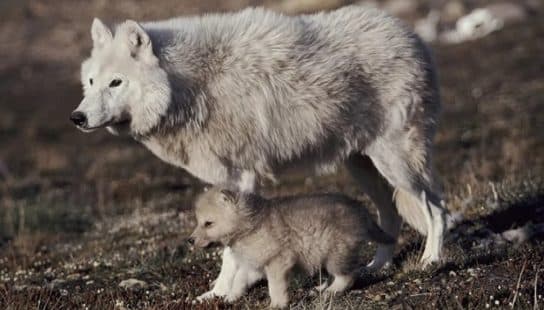
Polar wolf with puppy
Life span
In the wild, polar wolves live in the range from 5 to 15 years. Despite their good health, prolonged periods of hunger will significantly shorten their lifespan. It is extremely rare for polar wolves to be attacked by bears. There are fights between relatives. In captivity, these animals live up to 20 years.
