


In the biological classification of living things, an unusual order of cetopods is distinguished. It includes animals of four suborders: ruminants, calluses, pigs, and kitoancodonts. The latter unites aquatic mammals. Representatives of the hippopotamus family can live both in water and on land. The rest lead only an aquatic life: porpoises, dolphins and whales.
Description and appearance of the Japanese whale
Until recently, scientists have combined the Japanese whale with the North Atlantic whale. But later they were divided into two different types due to the difference in the DNA structure. Outwardly, they are hardly distinguishable. However, the Japanese have larger sizes.
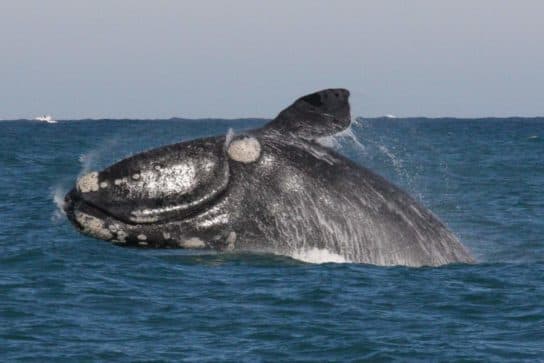
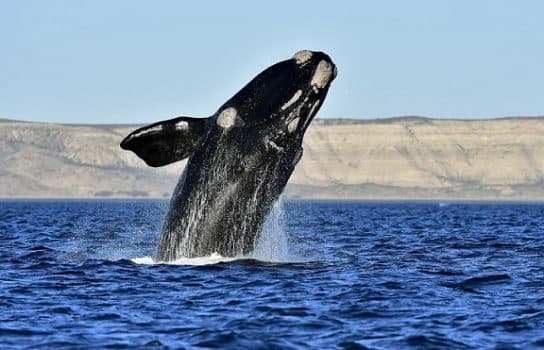
The Japanese whale is dark and large. The body length reaches 18.5 m, and the average weight of an adult is 60 tons. Males are inferior to females in size. Some females weigh 80 tons. Newborns are usually 6 m long and weigh no more than 1 ton. This species of whale has no dorsal fin. And the black caudal fin is very wide. It has a wide notch in the middle. The lateral fins are also large with pronounced phalanges. There is a white spot on the lower abdomen in the genital area. Each individual has a different shape and size. The large head of the animal is covered by the stratum corneum in the form of huge warts. Whales have a strongly curved mandible line. The whale is capable of releasing two jets of water up to 5 m in height.
Habitat of the Japanese whale
The Japanese smooth whale lives in the North Pacific Ocean. Its range extends from the Sea of Okhotsk to the Bering Sea up to the Gulf of Alaska. Sometimes whales of this species can be found near the territory of Mexico, but they rarely swim here.
They are characterized by seasonal migrations. In summer, they fatten up subcutaneous fat in the Sea of Okhotsk, near the Kuril and Commander Islands. In winter they migrate to the East China and Yellow Seas. Here they have cubs. Females give birth to them near the shores of Japan and South Korea.

The diet and lifestyle of the Japanese whale
Small crustaceans form the basis of the smooth whale’s diet. For example, copepods. Whales dive for plankton to shallow depths: no more than 20 m. They stay under water for 7 to 20 minutes. Not completely displayed on the surface. Although sometimes they jump high out of the water.
Compared to other species of whale, Japanese is not very fast. It develops a speed of up to 7 km / h. This largely influenced the decline in its number in the 19th-20th centuries. The fishermen called it “convenient”, as it was not difficult to catch a slow big whale.
Females are able to give birth between the ages of 6 and 12. Moreover, they give birth to one cub and is extremely rare. The interval between births is 2-4 years. Pregnancy in a female Japanese whale lasts 12-13 months. At this time, expectant mothers stray into separate groups. Although in normal times, whales lead a solitary existence or keep a maximum of 2-3 individuals.

Red Book
In 1986, a moratorium was imposed on commercial whaling. By this time, a very large number of whales of various species had been exterminated. The population of the Japanese right whale has not yet recovered. It is on the verge of extinction and appears in the endangered species list of the Red Book.
In the midst of hunting for smooth whales (1839-1909), according to unspecified data, whalers killed more than 30,000 individuals. Many whales were also killed illegally in the following years.
Now the decrease in the number of the species is affected by the general pollution of the World Ocean, the ingress of animals into fishing nets and under the propellers of ships. The total number of Japanese whales in the East Pacific Ocean and the Sea of Okhotsk is approximately 500 individuals. In addition, their low fertility prevents the whale population from fully recovering.
Interesting Facts
- The Japanese smooth whale can live to a fairly advanced age if it does not become the victim of an accident (for example, from a collision with a ship). His age is estimated at 70 years.
- In the process of breeding smooth whales, there is such a feature as sperm competition. In almost all species, the rivalry of males takes place in the form of a battle with each other. Smooth whales resolve this issue peacefully. They swim behind the female, mating with her in turn. The father becomes the one whose sperm cells quickly reach the egg and fertilize it.
- The testes of the Japanese whale weigh almost a ton. They produce large amounts of sperm to increase the chances of successful fertilization.
- The growths on the head and jaws of a whale are the stratum corneum. These formations are called callocytes. Whale lice live in them. They also settle on the soft skin of the genitals and in the area of scars or wounds.
- The Japanese smooth whale is IUCN-listed. In the Red Book of the Russian Federation, he is listed as endangered. Whale hunting is punishable by a fine. Strict enforcement of this prohibition is required.
