


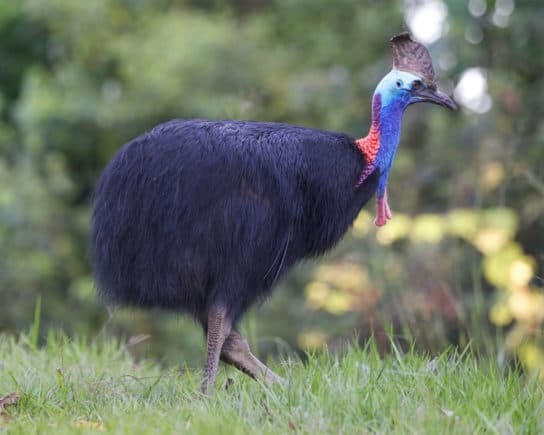
Cassowaries are large flightless birds. They are unique members of their family. The name of this bird, translated from the Indonesian language, means “horned head”.
Description
Today there are three subspecies of this bird: common or southern cassowary, muruk and orange-necked. All cassowaries have a horny ledge on their heads, the so-called helmet. The head and neck itself have no plumage and have a bluish-blue skin color, and by the earring on the neck you can easily determine the type. Muruk does not have it, the orange-necked earring has only one, and the common cassowary has two of them. The feather on the body of the cassowary is dark, almost black. The legs of these birds are incredibly strong and have three toes on which dangerous sharp claws are located, the main threat is the inner claw (the cassowary can kill it in one movement).
Common cassowary (C. casuarius)
Orange-necked cassowary (C. unappendiculatus)
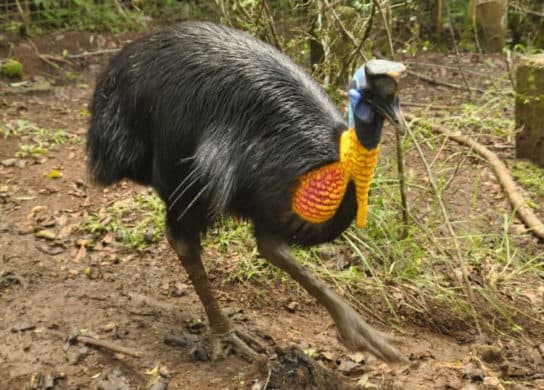
Kazuar muruk (C. bennetti)
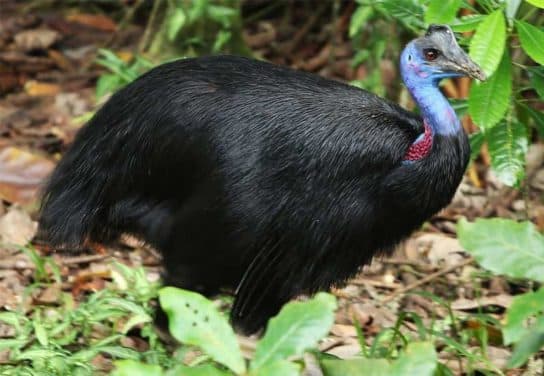
The bird’s weight reaches 60 kilograms. Females of this species are somewhat larger. They are very easy to distinguish from males by their brighter feather and large helmet.
Habitat
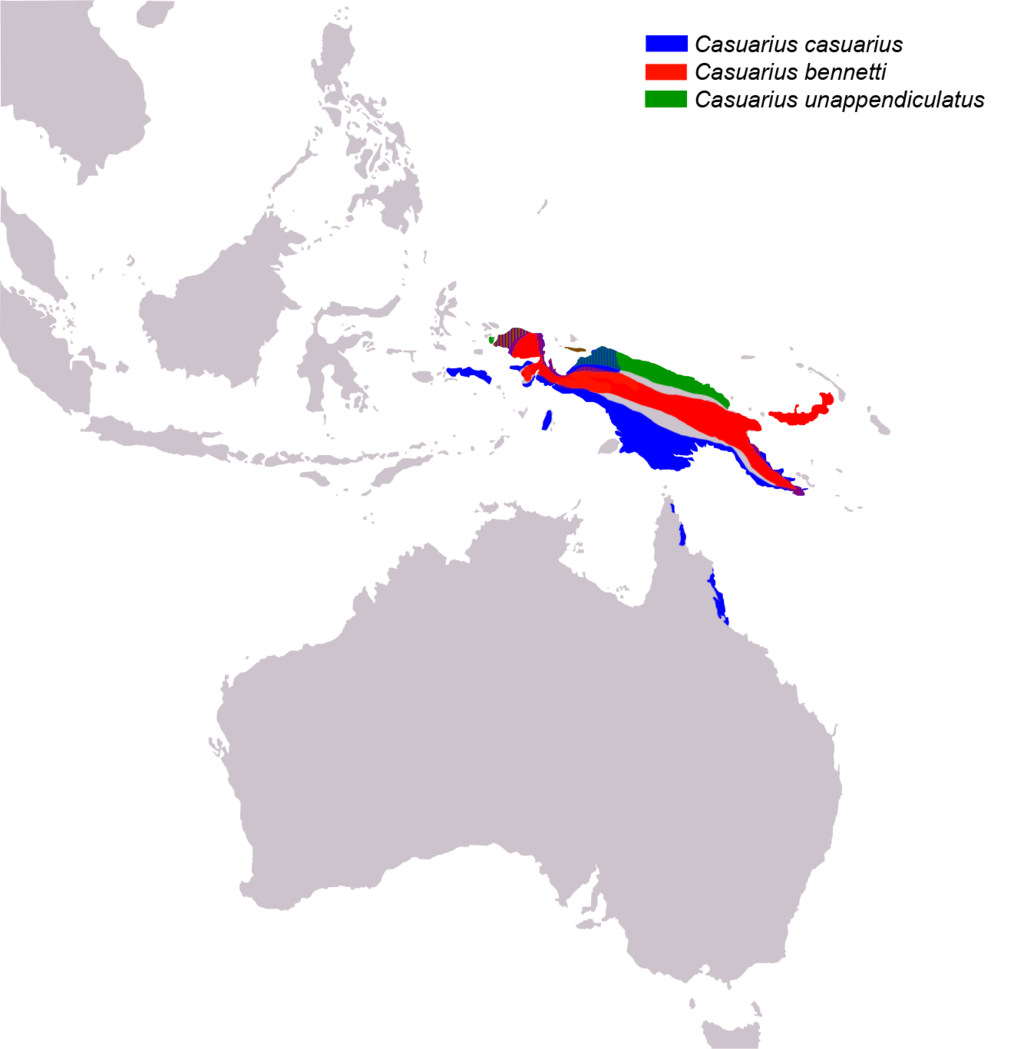
Cassowaries are forest dwellers. They live exclusively in the rainforest of New Guinea, as well as in the northeastern regions of the Commonwealth of Australia. It is noteworthy that the habitats of the three species overlap slightly, but the birds try to avoid interspecific encounters. That is why they settle at different heights. For example, muruk lives in high-mountain forests; The orange-necked cassowary prefers forests at low altitudes (low-lying), but the southern cassowary prefers forests at an altitude of 1000 meters.
Also, the cassowary can be found on the islands neighboring to New Guinea: Aru and Seram (there you can find an ordinary cassowary); Muruk settled on the islands of New Britain and Yapen; and on the island of Salavati there are orange-necked cassowaries.
What eats
Most of the cassowary’s diet consists of fruits. Moreover, the fruits can be either fallen or plucked from the lower branches of trees or bushes. Especially during the dry season, the forest is replete with fallen fruits and this is the best time for the cassowary.
In order to make up for the lack of proteins in the body, cassowaries include various forest mushrooms, as well as various reptiles, in their diet. For example, snakes, frogs and small lizards have been found in the stomach of a cassowary.
For better grinding of food, cassowaries, like many other birds, swallow small stones (the so-called gastroliths).
Natural enemies
In its natural environment, the cassowary has no enemies due to its size and powerful legs, which makes it a very dangerous opponent.
Despite the impressive protection, an adult cassowary still has one enemy – a man. And this is due not only to deforestation (its natural habitat). The tribes hunt cassowaries for delicious meat and beautiful feathers. Outfits are made of feathers, used as decoration. Arrowheads are made from sharp and strong claws, and the bones of the legs are used to make tools.
For clutches and newly hatched chicks, wild dogs and pigs can be a threat and can easily ravage the nest.
Interesting Facts
- Cassowaries entered the Guinness Book of Records as the most dangerous bird on our planet.
- Cassowaries are amazing in that all care for future offspring lies with the male. First, he collects a nest from fallen leaves and twigs, then the female lays there several green eggs (the weight of each egg can vary from six hundred to seven hundred grams). Then the male incubates the offspring for two months, and then for almost a year and a half protects the offspring and teaches them to get their own food.
- Cassowaries are excellent runners. Despite the fact that they live in the forest, they are able to easily reach speeds of up to 50 km / h, and also easily jump over 1.5 bushes.
