


Appearance
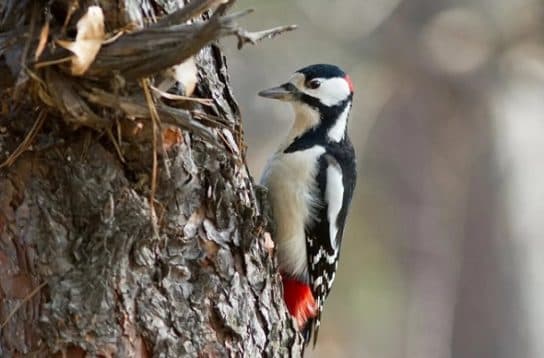
Great spotted woodpecker (common woodpecker, spotted woodpecker) its size is a bit like a thrush. The Great Spotted Woodpecker varies in length from 22 to 27 centimeters, and its weight can range from 60 to 100 grams. This representative is noteworthy for its characteristic color, in which white and black colors prevail, combined with bright red stripes on the undertail. All subspecies of the great spotted woodpecker are endowed with a variegated color.
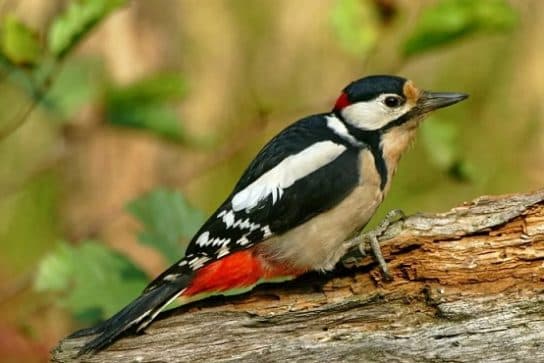
On the front of the head, in the region of the back and upper tail, the plumage is predominantly black with a bluish tint. The area of the forehead, belly and shoulders is white with a brownish tint. Flight feathers on the wings are black with small white spots. Sexual dimorphism lies in the color of the plumage: in males there is a red spot on the back of the head, while in females it is black.
Woodpeckers have distinctive tough and pointed feathers that allow them to fly well. However, most of them prefer to climb trees.
Habitat
The territory of distribution of the great spotted woodpecker extends practically in the entire Palaearctic. Some populations are found in Europe, Africa and the southern Balkans. These birds are also found on some islands of the Mediterranean and Scandinavia. On the territory of Russia, great spotted woodpeckers can be found on Sakhalin.
As a habitat, these representatives prefer to inhabit small islands with rich vegetation, as well as parks and gardens. By themselves, great spotted woodpeckers are easily adapted to any type of biotope. Inhabitants of North Africa inhabited cedar forests, olive groves and various mixed woodlands. In Poland, great spotted woodpeckers are found in oak and alder groves and in some parks rich in old trees.
Nutrition
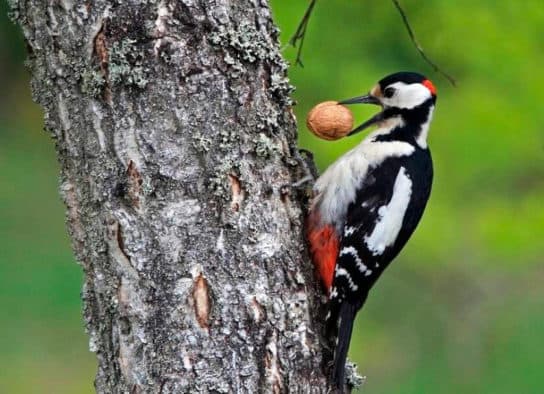
Great spotted woodpeckers prefer various insects and larvae as their main food. These birds get the larvae with the help of their sharp beak, making small holes in the bark of the tree. Throughout the year, various berries, seeds and nuts can be preferred as food. As a rule, in the winter period they choose plant food, since it is problematic to look for larvae and other insects during this period. In order to cope with the dense nut shell, great spotted woodpeckers form anvils of sorts in the cracked bark where the nut or acorn is placed. More than 50 such “anvils” can be found in the woodpecker’s habitat. Also, these birds can feed on seeds and nuts of hazel, hornbeam and almonds.
Reproduction
Most members of the great spotted woodpecker population are monogamous. The period of mating activity lasts until March, and already in mid-May the couples are fully formed. Then, an active search for a hollow begins to arrange a nest. As a rule, great spotted woodpeckers choose hollows at a height of up to 8 meters. The egg-laying period starts at the end of April. In the formed nest, the female lays from 4 to 8 white shiny eggs.
The incubation period lasts for 12 days, after which small and helpless chicks are born. By the 10th day of life, the cubs begin to climb. The female and the male are looking for food for themselves and their offspring.

The nesting period for chicks lasts more than three weeks. Then the already matured great spotted woodpeckers begin to learn to fly. Some of the cubs move behind the female, and the second part – behind the father. Having learned to fly, chicks are considered ready for independent life.
Lifestyle
For the most part, the great spotted woodpecker is considered a sedentary bird, which quite rarely flies to distances exceeding 15 kilometers from the nesting territory. The exception is woodpeckers that populate the Siberian and Scandinavian forests. They can wander over relatively long distances in search of cones.
Great spotted woodpeckers are considered to be quite noisy birds. Some individuals can live near human homes. Such birds prefer a lonely life. Sedentary individuals have their own territory. If a stranger appears on the territory of the Great Spotted Woodpecker, this can often lead to a fight between birds. Such situations are common during their breeding season.
