


Coot bird (coot) or black loon is waterfowl and belongs to the family called “shepherd’s”. She is included in the “crane” order and prefers to live near lakes and lowland rivers.
In appearance, there is a distinctive feature: in the central part of the head above the beak there is a spot of skin without feathers. It merges with the beak, which has the same color. Therefore, the bird was named coot.
Appearance
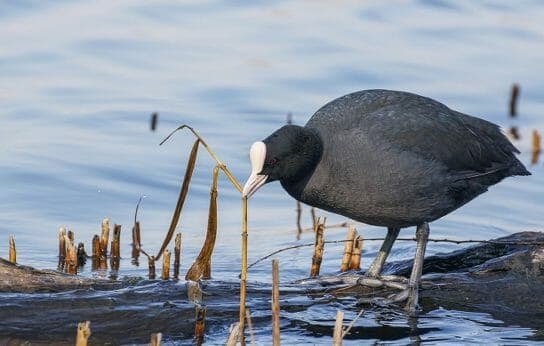
Birds that belong to the coot species have black plumage. A leathery spot in the forehead is colored differently in coots living in different parts of the world:
- European coots have a white spot;
- South American red-fronted coots – a red spot;
- white-winged coots are a bright yellow spot.
The birds are small in size, their body length is about 40 cm. But some of them are more than 60 centimeters long (horned and giant coots).
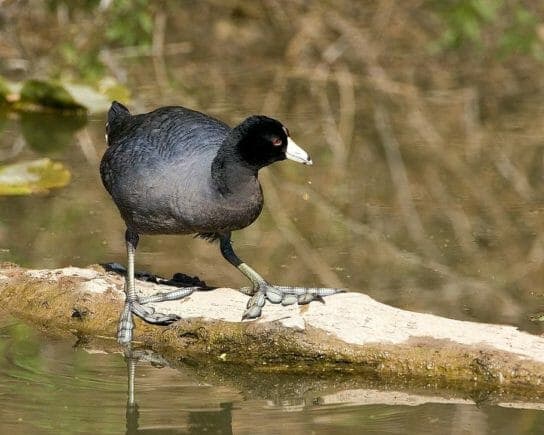
The pelvis and legs are adapted for swimming and diving. Under the tail, this species has soft and white feathers. The structure of the toes is peculiar: leaf-like blades are attached to them, which open during swimming. The color of the legs is yellowish or orange, the limbs are black, the color of the blades is almost white.
Coots have small wings, they fly little, mostly swim. But coots living in the northern regions make long-distance flights.
In our country, there is one representative of the species, called common bald… She has gray or black, breast and belly have a grayish-smoky shade, and the beak and spots are white. The body length of the common coot is only 38 centimeters, the weight is one and a half kilograms. The eye color is bright red.
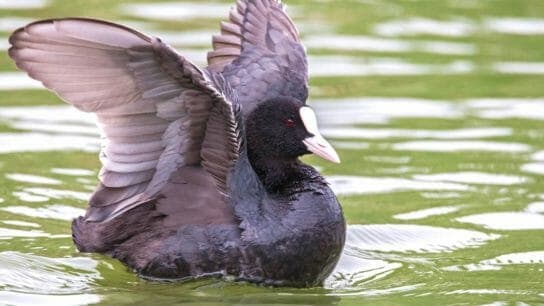
Coots have a dense build. Males are slightly larger than females and their feathers are darker, and the frontal mark is larger in size. Young females are brownish with a light gray belly.
Listening to the voice of a coot
Where dwells
Coots inhabit many parts of the world. You can see them:
- on the continent of Eurasia;
- in North Africa;
- in Australia;
- in New Guinea;
- in America.
The vast area of the bird range can be explained by the fact that long-distance flights are unacceptable for them. If you have chosen a place during the flight, you can stay there and do not return to your previous place.
The steppe and forest-steppe zones were occupied by coots on Russian territory. The places of their settlement are reed and grass thickets near lakes and in the floodplains of slowly flowing rivers.
Types of coot
The shepherd family includes only eleven subspecies, called coots:
- crested;
- Hawaiian;
- ordinary;
- American;
- gigantic;
- yellow-billed;
- redheads;
- andean;
- West Indies;
- horned.
- white-winged.
There was another species called mascarene coots. They lived on two islands in the Indian Ocean (Mauritius and Reunion). In the 18th century, this species disappeared, due to the development and desiccation of swamps, as well as uncontrolled hunting.
Lifestyle
The coot is active during the daytime. Sometimes she is awake at night. But this happens only in the spring or during the migration period when making evening flights.
They are in the water almost all the time and are excellent swimmers. When the coot swims, it alternately stretches and presses its neck, shaking its head. The tail is submerged in water. On land it is not long and moves slowly, trying to raise its paws higher. Basically, the coot occupies the coastal hummock, on which it cleans its feathers.
If the coot senses danger, it dives into a depth of about four meters or hides in thickets of grass and reeds.
The coot does not like to fly, but if the need arises to take off, then it scatters along the water surface (in length, moving eight meters) and takes off sharply. Her flight is a little heavy, and she is not able to maneuver, but her speed is sufficient.
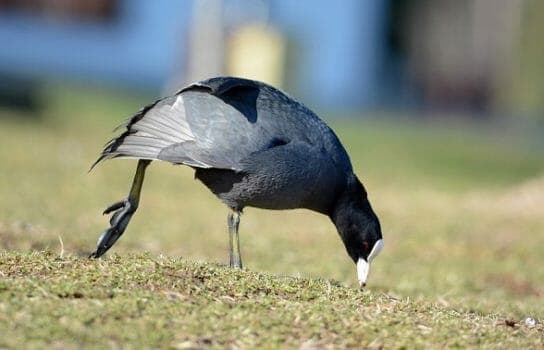
The coot flies reluctantly and very rarely comes out on the coastal land. Coming ashore, the coot usually finds a coastal hummock, on which it puts its feathers in order. The bird feels most comfortable when swimming in the water, so most of the time it is in it.
By its nature, the coot is a very gullible bird and sometimes allows predators and hunters to come close enough to it, sometimes it pays for this with its life. It has a mostly peaceful character, but will fight with ducks or swans living in the neighborhood for a tasty piece of food.
Coots make migratory flights in groups or individually. Arriving on the territory for wintering, they unite in large flocks. The migration routes of coots do not have a definite pattern: they fly in constantly changing directions.
A large number of coot birds do not reach the life expectancy intended by nature due to their naivety and the influence of external factors. Researchers have found that a coot can live a maximum of eighteen years.
Nutrition
Coots prefer plant foods. Their diet contains more green algae. They feed on such plants growing in water:
- duckweed;
- peristolistnikom;
- hornwort;
- algae.
But sometimes they catch and eat small fish, insects, fry. Coots destroy the dwellings of neighboring birds and eat eggs.
Reproduction
Coots create pairs that live together permanently. They are monogamous. After the flight, the mating season begins in coots. The formed pair has constant mutual courtship and nest building. It is built on the water surface in reed and reed thickets, and is made of grass stems and leaves. The construction of the nest is carried out jointly by the feathered family.
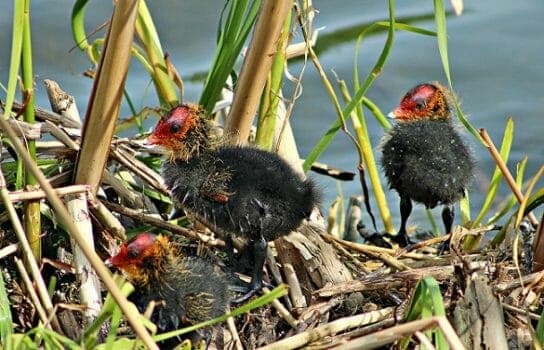
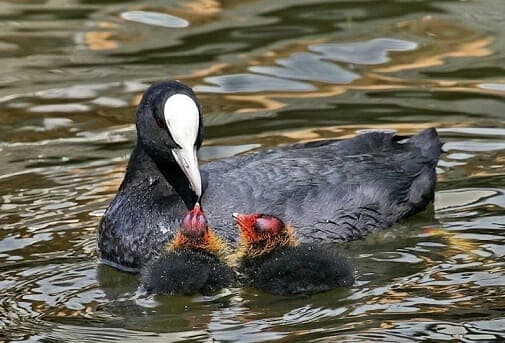
Black loon chick
The coot does not allow even relatives of birds from its flock to its nest and fights with any intruder, protecting its territory. Nests are built at a distance of 30 to 60 meters. If an alien appears on the territory occupied by coots, they scream loudly, swim out to him, drive him out of its borders.
The female can lay eggs not once, but two or three times, in the amount of 6 to 13 pieces. The color of the eggs is sandy gray or clayey. Small brown specks or violet-gray spots appear on the surface of the shell. The female and the male incubate eggs together. When the female leaves the nest to eat, the male replaces her.
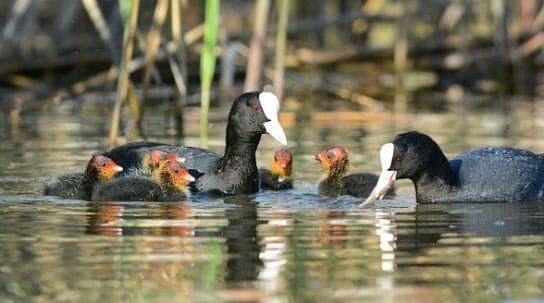
Chicks hatch after three weeks. Their parents feed them for about two weeks. After two days, they are already able to leave the nest and swim with their father and mother.
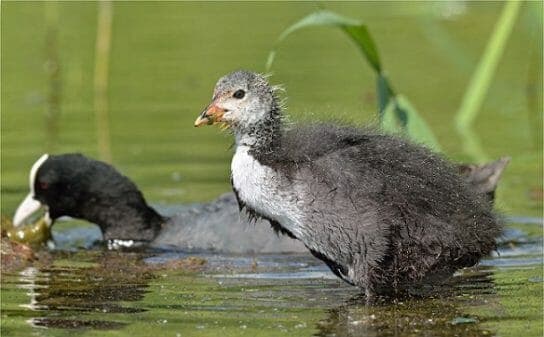
During the period when coots breed, they hide from strangers and hide in thickets. After about 2-2.5 months, the chicks move on to an independent life. Sexual maturity in young birds occurs in the next season.
Natural enemies
Coots have a lot of enemies in nature. They are prey for the following predators:
- Crow;
- marsh harriers;
- falcons;
- eagles;
- seagulls.
Coots love to eat: otter, mink, wild boar and fox.
Population
Coots are numerous. These birds multiply quickly and easily get used to a new place. The available species of coots are stable in number and not subject to extinction.
There are factors in the world that affect the decline in the population:
- cutting down reeds;
- drainage of reservoirs;
- hunting;
- ecology.
These reasons do not have a significant impact on the number of coots. Today, for many species, it is not necessary to apply protective measures. But some are under protection. For example, the Hawaiian coot.
Interesting Facts
1. Representatives of the coot species, which are called horned, throw a lot of pebbles into the water to arrange a nest, and create a nest on a hill formed from them. The stone island created by them reaches a mass of up to 1500 kg.
Coots, called giant coots, build their nests on rafts up to four meters in diameter. Such a raft can easily support a person weighing 75-80 kg.
2. The mating season is accompanied by games on the water. The female and the male swim, moving towards, with loud cries, then, connecting their wings, perform synchronous movements. After that, they diverge in opposite directions. At the end of the game, the couple team up and swim side by side.
3. When creating a hazardous situation, the coot is protected as follows:
- jumps over the surface of the water;
- hits the water with its paws and wings with great force, causing splashes;
- stuns its enemy with powerful blows with its beak and paws.
It happens that the whole flock attacks the enemy and defends itself from him.
