


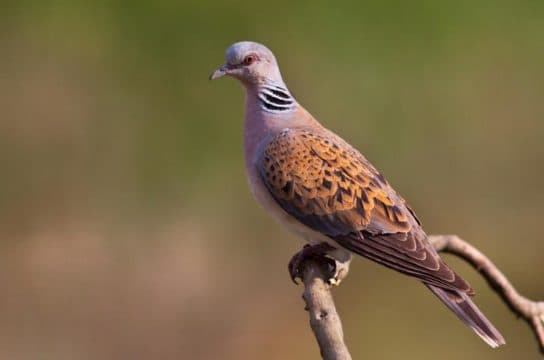
Common turtledove, a bird from the family of pigeons, a symbol of the Christmas holidays, innocence, purity and enduring love.
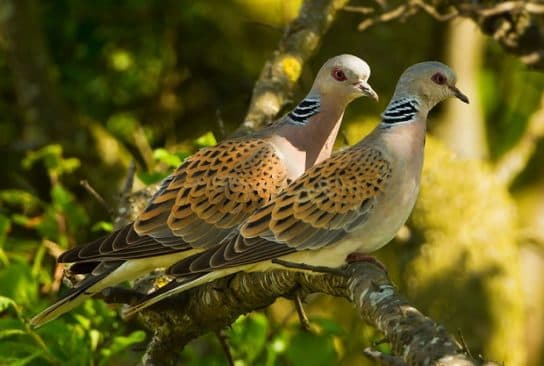
Turtle Doves embody loyalty and love, perhaps because of biblical references (especially the Song of Solomon verse), because of mournful singing, and because they form strong couples.
Description of common turtle dove
The distinctive colored stripe on the top of the neck gives the impression that the pigeon is pulling its head in like a turtle, hence the “turtledove” part of the name. Common Turtle Doves are light gray or brown with black spots on the wings and white tail feathers. The adult male has bright pink spots on the sides of the neck, reaching the chest. The crown of the adult male is clearly visible due to its bluish-gray color. Females are similar in appearance, but their feathers are dark brown and slightly smaller in size. Juniors of both sexes look like adult females, only darker.
Mating rituals of turtle doves
The graceful bird has an interesting mating ritual. The male flies and hovers in the air, spreading its wings and lowering its head. After landing, it approaches the female, protruding its chest, shaking its head and screaming loudly. Their mating call is often mistaken for the cry of an owl. If the turtledove is impressed with the grooming, she agrees to romantic mutual grooming of feathers.
As soon as two birds begin to live together, they form a strong paired bond, which is not interrupted for several breeding seasons. Like most birds, common turtle doves nest in trees. But unlike other species, they also nest on the ground if there are no suitable trees nearby.
Both parents are involved in the incubation process. These birds take care of their offspring and rarely leave their nests unprotected. If a predator discovers a nest, one of the parents uses a decoy maneuver, pretends that its wing is broken, flies as if injured. When the predator approaches, it flies away from the nest.
What do turtle doves eat
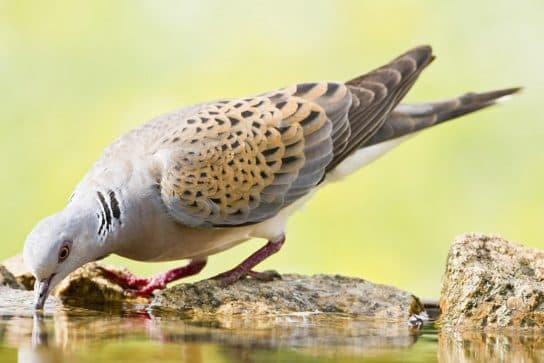
The turtle dove’s diet is a bit monotonous compared to other songbirds. They do not eat snails or insects, preferring rapeseed, millet, safflower and sunflower seeds. From time to time, the common turtledove eats some gravel or sand to aid digestion. Sometimes they visit bird feeders, but more often they look for food on the ground.
What are common turtle doves sick with?
The reason for the decline in the population is trichomoniasis. Recent studies have shown a high prevalence of infection in common turtle doves.
Interesting Facts
- This is one of the smallest pigeons, weighing from 100 to 180 g.
- Turtle doves arrive at their breeding sites in late April and early May, in late summer and early autumn they return to winter in West Africa.
- English Turtle Doves winter in the semi-arid regions of Senegal and Guinea. Birds from Eastern Europe in Sudan and Ethiopia.
- Migratory birds are harmed by gourmet hunters as they fly through the Mediterranean countries. In Malta, the law permits the spring hunting of pigeons, in other countries they are hunted predatory and illegally.
- The turtledove population has declined by 91% over the past 10 years. The degeneration of the species is associated with problems in wintering and breeding grounds, and not with hunting.
- Seeds are the favorite food of turtle doves. Weed control in agriculture reduces the pigeon’s food supply.
- One of the favorite food plants of the turtledove is the pharmacy smoke. The plant prefers light, dry soils. Research has shown that weed seeds account for 30-50% of a bird’s diet.
- The turtledove’s song is soft, soothing. Singing is heard from the nest all summer long.
