


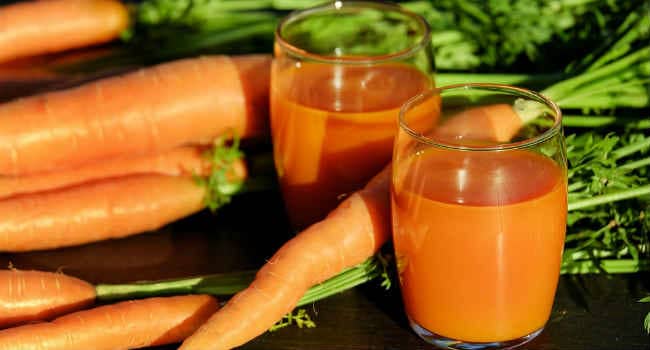
Carrots are a seasonal plant. A new crop of carrots is harvested in late summer in early autumn. But it is excellently stored until the next harvest, retaining almost all of its useful properties. Carrots are prized not only as a delicious vegetable that is used in many dishes, but also for their benefits to the body. It is about the benefits of carrots for the body of adults, the elderly and children that we will talk about today in this article. Let us dwell on the possible harm that can be caused by the use of this vegetable.
Carrots as a vegetable description
Who doesn’t love carrots? Probably, many will answer this question in the affirmative. Adults and children love carrots, because they have a great taste, sweetness and juiciness.
Carrots are biennial plants from the umbrella family. In the first year of life, it forms a leaf rosette and a root vegetable, which is eaten. The next year, a stem with leaves is formed and the seeds ripen.
The ancestor of modern carrots is a plant grown in Southwest Asia more than 4 thousand years ago. True, it has little resemblance to modern carrots, it was bitter in taste and purple in color. It was grown only for the sake of seeds and tops.
Much later, the traditional orange varieties of carrots were bred. thanks to the work of breeders, now there is a whole palette of carrots according to the color of this vegetable. To date, scientists have at least 60 varieties of carrots, yellow, orange, purple and white varieties of carrots. At the same time, the Mediterranean is considered its homeland.
The main territories of purposeful cultivation include temperate countries, Africa, Australia, New Zealand, America (North and South), Afghanistan, as well as Greenland and the Arctic.
Depending on the varietal affiliation (and there are only three of them: early – the root ripens in 50 days, medium – the ripening period up to 80 days and late – up to 150 days), the durability and storage quality of the freshly dug product will be calculated. Experts recommend harvesting the late varieties of carrots for storage.
The first who began the widespread use of carrot rhizomes and plant seeds were the ancient Romans, although this root crop is known approximately, as mentioned above, for about 4 thousand years.
In Kievan Rus this plant was first mentioned by monks in church receipts and expenditure books, indicating that carrot rhizomes were also supplied to the tsar’s table. In fact, carrots won the trust of Russian housewives only in the 17th century, becoming a crown component both in a separate variation and as a basis for such a dish as pies with carrot filling.
It is worth noting that carrot tops have always been used in the preparation of botvinnik soup, and if a girl did not know how to cook it, then no one took her in marriage. At the moment, it is customary to allocate at least a small piece of land for carrots.
Useful properties and composition of carrots

Regardless of how the carrot looked before and how it looks now, who was the first to grow this root vegetable, carrots remain a valuable source of vitamins and minerals that have a beneficial effect on the human body. Carrots are used in official and traditional medicine.
Based on numerous studies, we can confidently talk about the rich chemical composition of a completely familiar vegetable, which is never forgotten.
For example, carrots have:
- Water (or rather, a healthy vegetable liquid);
- Zolu;
- Starch;
- Mono – and disaccharides, represented mainly by glucose;
- Organic acids;
- Alimentary fiber;
- Nicotinic acid (or PP vitamins);
- Blood-clotting vitamin K;
- Biotin (known as vitamin H);
- Vegetable fat tocopherol (or vitamin E);
- Ascorbic acid;
- Basic B vitamins (from B1 to B9);
- Beta carotene, which, in the process of synthesis and assimilation by the body, turns into retinol (or vitamin A);
- Formed by sunlight vitamin D;
- Essential minerals in the form of nickel, aluminum, lithium, vanadium, molybdenum, cobalt, chromium, copper, zinc, fluorine, boron, manganese, selenium, iodine, iron, phosphorus, sulfur, chlorine, magnesium, potassium, calcium and sodium (especially the salts of these constituents are useful);
- Proteins, fats and carbohydrates;
- Carotenoids: phytoen, phytofluen, lycopene;
- Flavonoids (natural antibiotics quercetin and kaempferol);
- Pectic substances;
- Fatty and essential oils;
- Amino acids (lysine, ornithine, cyst, histidine, tyrosine, leucine, serine, threonine, proline, asparagine).
Despite the rich vitamin and mineral composition, carrots are low in calories. For 100 grams of product, it is only 26 to 32 kilocalories (depending on the sugar content in a particular variety). In terms of beta carotene content, this vegetable crop surpasses all vegetables, including pumpkin, and fruits in terms of carotene content (except, perhaps, sea buckthorn).
For those interested in the energy value of products, that is, the ratio of proteins, fats and carbohydrates (BZHU), it is 15/3/79%.
Carrots are good for health and preservation of youth. It perfectly strengthens the immune system, after suffering serious illnesses to restore the body.
Carrots contain substances that improve blood composition and increase hemoglobin.
With regular use, carrots cleanse the blood and remove toxins, improve metabolic processes in the body.
When properly stored, vitamins in carrots are protected practically throughout the winter, which makes it useful for the prevention of spring vitamin deficiency.
Potassium improves the functioning of the heart system, helps to remove excess fluid from the body.
The presence of fiber improves the functioning of the gastrointestinal tract. Everyone knows that to preserve vision, you need to eat carrots.
The benefits of carrots for the body
All the benefits of eating carrots will depend not only on their basic chemical constituents, but also on the way they are used. It is generally accepted that the vegetable provides maximum benefits only in its raw form, but after detailed study it was found that the beneficial activity of boiled and baked carrots increases by 14%. And this fact does not at all reduce the benefits of such a commonly available vegetable. So it’s useful to use it:
- With reduced immunity;
- With vitamin deficiency;
- Nursing mothers (milk production increases);
- In order to prevent the development of thrush;
- For babies, to protect their gums, and subsequently erupted teeth;
- With polyarthritis and mineral metabolism disorders;
- In order to improve the work of the small and large intestines;
- To get rid of slagging of the body and constipation;
- To lose weight and lose weight;
- In the prevention and treatment of “night blindness” (a person does not see well at dusk and at night), cataracts, conjunctivitis and a general decrease in vision with constant eye fatigue;
- With urolithiasis and the presence of sand in the bladder;
- As a light choleretic agent that does not give pain due to the analgesic effect;
- To prevent myocardial infarction, strengthen the heart muscle and vascular walls;
- In the treatment of pulmonary diseases (asthma, bronchitis, pneumonia);
- In the prevention of the development of oncological diseases (the main action is assigned to antioxidants);
- For the purpose of strengthening nails and hair;
- To give a healthy look to the skin;
- Grated carrots are usually applied externally to purulent wounds and parts of the skin affected by a burn;
- Carrot juice, consumed on an empty stomach in small quantities, helps to get rid of worms;
- For the correct full-fledged formation of the fetus (in particular, carrots are useful for the child’s brain);
- To improve the work of the gastrointestinal system;
- To destroy the pathogenic flora of the oral cavity.
Read on: Carrot juice benefits and harms
Due to the fact that carotenoids are fat-soluble substances, when preparing carrot dishes, it is worth filling them with sour cream, cream, vegetable or butter.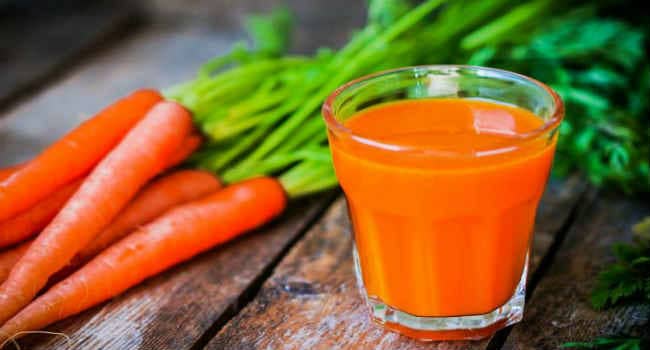
Healing properties of carrots
This vegetable is world famous and available to everyone. Often it is customary to use it in the preparation of almost all types of dishes. But many inhabitants of the planet have limited knowledge of its medicinal properties, which allows us to tell much more about the product. Its healing properties are recognized not only in traditional medicine, but also in official medicine.
Carrots have the following medicinal properties:
Anti-inflammatory;
Anthelmintic;
Tonic;
Antiseptic;
Expectorant;
Choleretic;
Pain relievers;
Wound healing.
Carrot juice is indicated for:
Polyarthritis;
Cholelithiasis;
Anemia;
After a heart attack.
The drug “Daucarin” is produced from carrot seeds, which has antispasmodic and vasodilating properties and is used to treat chronic coronary insufficiency.
Carrots are widely used in folk medicine. Here it is used to treat cough, improve appetite, as an anthelmintic agent, as a remedy for relieving asthma attacks.
Shown carrots for diabetes, nephritis, dysbiosis, oncology. Moreover, for these diseases, carrots are best consumed boiled.
Place carrots is used to heal pustular skin lesions, frostbite, burns.
It is impossible not to note the healing effect of this vegetable on the condition of the skin, hair, nails. As a natural antioxidant, it slows down the aging process and prevents the appearance of wrinkles.
Potential harm to carrots
Do not think that such a useful root vegetable from all sides cannot lead to negative consequences if consumed in violation of the established rules. Therefore, it is not recommended:
- There are more than two carrots, each weighing 75 g, per day;
- Do not exceed the norms for the use of carrot juice;
- Start eating a vegetable for people with allergies without first consulting a doctor;
- The same applies to diabetics (after all, the vegetable is sweet and contains a lot of glucose);
- The use of carrots in any form with exacerbation of peptic ulcer and gastritis.
When a person ignores these rules, he risks getting:
- A negative allergic reaction (sometimes it comes to anaphylactic shock);
- Serious stress on the liver;
- Nausea and vomiting;
- Yellow spots on the palms of the hands (then you will have to exclude carrots from the diet for a long time);
- Complete disgust for food (most often this applies to children).
As you can see, there are not so many contraindications to the use of tasty and healthy carrots. Much more useful in it.
Nutritional table for raw carrots per 100 grams of product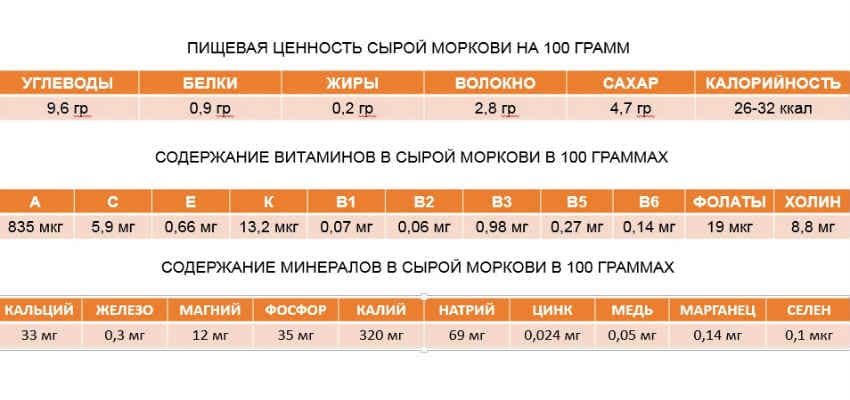
Learn more about the benefits of carrots and their beneficial properties for the human body from this video of the “Living Healthy” program
