


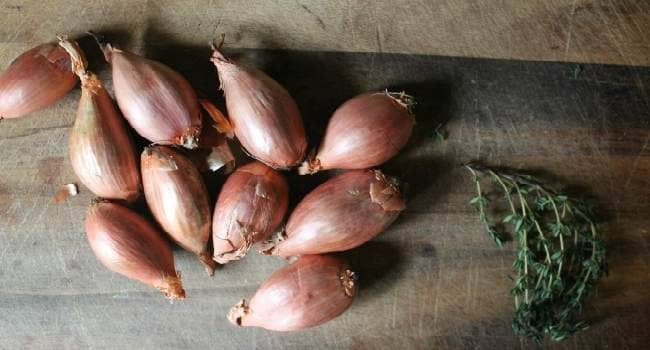
This type of onion has been known since antiquity. The ancient Greeks and Romans even claimed that it had aphrodisiac properties. Popular with modern gourmets and healthy food lovers. Rich in minerals, vitamins and other nutrients, shallots are an excellent food for a healthy balanced diet with a wide range of nutraceutical properties.
Shallots what they look like
Like onions, it belongs to the genus “Onions” (Allium) of the family “Onions” (Alliaceae).
The homeland is considered to be Central and Southeast Asia. He was well known to the inhabitants of the territory of modern Iran. It is believed that it was the Iranians who brought it to other regions. Today it is cultivated as a commercial crop in many countries around the world.
It differs from its close relative onion by a small onion and a milder taste.
The bulb is oval, tapering slightly towards one end. Consists of several heads, the number of which reaches five. The diameter of one bulb is about 4-5 centimeters. Covered with thin red-gray or light brown scales.
Grown as a perennial or annual plant. Young greens are cut on a feather.
Shallots are also called Ashkelon onions. This name comes from the ancient Palestinian city of Ascalon. Today it is known as Ashkelon. The ancient Greeks believed that this particular region was the birthplace of shallots.
Why is the chemical composition useful?
In terms of its chemical composition, it differs little from ordinary onions. Contains:
Minerals: potassium, phosphorus, manganese, iron, potassium, zinc, copper;
Vitamins: C, A;
Vitamin B complex;
Flavonoids;
Allicin;
Carbohydrates;
Protein.
There is practically no fat and no cholesterol in it.
The calorie content is 72 kcal per 100 grams.
Beneficial features
100 grams of onions provides 1190 IU of vitamin A, which is 35 percent of the required daily requirement. It belongs to powerful antioxidants. Protects against the oxidative effects of free radicals. Serves for the prevention of lung and oral mucosa cancer.
Pyridoxine or vitamin B-6 plays an important role in the functioning of the nervous system, increases the level of GABA.
Folate, represented by folic acid, is essential for cell division and DNA synthesis. Participate in the formation of red blood cells.
In addition to these vitamins, thiamine, riboflavin, niacin, pantothenic acid are present in it.
Allicin belongs to antioxidants. It lowers cholesterol levels. Possesses antiviral, antifungal, antibacterial properties.
In addition, it increases the elasticity of blood vessels, thereby helping to lower blood pressure. Studies show that allicin inhibits the formation of platelets in blood vessels.
Shallots are an excellent source of selenium. A trace element that protects cells from aging, improves the condition of the skin and hair.
Benefit for health
Thanks to the presence of antioxidants and other nutrients, it helps:
Normalize blood pressure;
Improve the condition of the blood vessels;
Protect against heart disease;
Improve appetite;
Normalize digestion;
Increase the digestibility of food;
Improve eyesight;
Remove toxins;
Prevent cell aging;
Boost immune defenses;
Reduce sugar levels;
Prevent bone breakdown;
Protect against cancer (especially cancer of the digestive system);
Strengthen blood circulation;
Improve brain function;
Reduce cholesterol levels.
Just like regular onions, it is good for skin and hair. Improves hair growth and prevents hair loss by stimulating blood circulation in the scalp. For this reason, it is not only eaten, but also used in masks.
It is recommended to add it to fried and fatty foods, which facilitates their digestion and reduces the negative effect on the esophagus.
With disinfecting properties, it kills any infection in the intestines. For the same reason, it is an excellent preventive measure during the period of infections.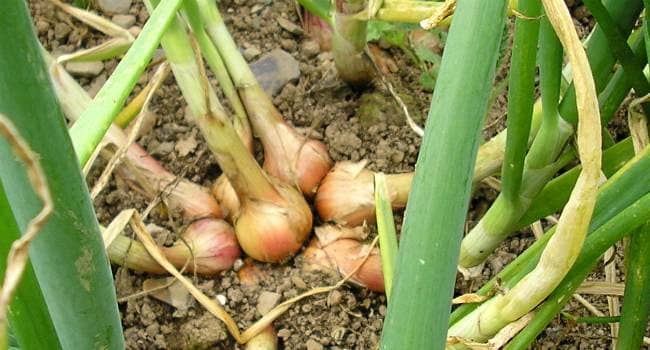
Serves as the prevention of diseases of the coronary and peripheral vessels. Reduces the risk of heart attacks and strokes.
It is recommended to be included in the diet of the elderly to improve overall health.
Medicinal properties
Shallots are used in folk medicine along with onions. Possesses:
Anti-inflammatory;
Antiviral;
Antimicrobial;
Antidiabetic;
Immunomodulatory;
Disinfectants;
Antimutagenic;
Antioxidant
properties.
It is used to treat wounds, abrasions, burns by applying a cotton swab dipped in juice to the damaged area.
During the period of colds and infectious diseases, it can be used to treat cough, bronchitis.
Cooking applications
Shallots are widely used in cooking. It is added when stewing vegetables, in frying for first courses, meat, fish, sauces. Serves as a filling in baked goods. In many recipes of Asian and Eastern cuisine, it is added to curries, chutneys, pasta.
Since the bulbs are small, they are often pickled.
Unlike onions, it is not as spicy. Although when sliced, it causes tears from the eyes. It is sweeter and has a more delicate aroma. Virtually no effect on bad breath.
Small onions can be used whole or cut in half.
Due to its smaller size, it cooks faster.
Cut into cubes and add to salad.
Thinly sliced onions are caramelized and seasoned with herbs and spices. They are added to hamburgers, sandwiches, pizza or as an addition to fried chicken and other meat, fish dishes.
How to choose and store
Fresh onions with green feathers are available in spring and early summer. The excavated material must be stored in a cool dry place or refrigerator. True, unlike usual, it is not stored for a long time. Therefore, try to marinate, freeze or dry the excess.
When buying from the store, choose firm, dry, non-sprouted bulbs. It starts to deteriorate faster, to rot from above. Black spots appear on the skin, indicating spoilage.
Harm and contraindications
Used in large quantities can interfere with the delivery of oxygen to cells and tissues.
Not recommended for people suffering from:
Diseases of the gastrointestinal tract;
Frequent constipation;
Diseases of the genitourinary system.
Although less pronounced than the common onion, it can irritate the mucous membranes of the skin and eyes. This is due to the release of the allyl sulfide compound, which converts to sulfuric acid on contact with a wet surface.
Most of this substance is concentrated at the end of the root. To reduce this effect, immerse the onion in cold water for a few minutes.
Shallots, or as gardeners often call it, is a family, healthy nutritious product. In early spring, it grows back quickly and produces vitamin-rich greens. It can be cut several times during the season.
The bulbs remaining in the ground do not disappear and give new shoots. Perhaps that is why it grows in the beds of many gardeners. Easy to grow at home. Greens give more than onions.
