


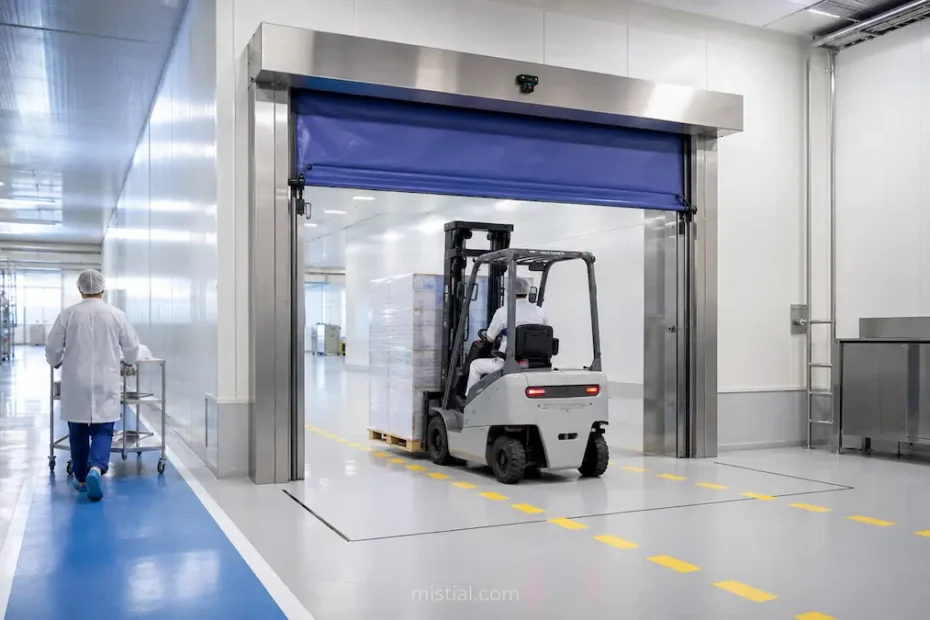
A high-speed door is often specified by width, height and opening speed. Those numbers matter, but they do not tell you whether the door will work well once forklifts, carts and people begin using the opening all day.
TDK’s HT 3000 Clean Room High Speed Door is designed as an internal door with a 304 stainless-steel frame, a 0.8–2.0 mm fabric curtain and PLC/servo control. TDK lists a maximum size of 5000 × 5000 mm, an opening speed of 1.2 m/s and a closing speed of 0.6 m/s.
In a food or pharmaceutical plant, I would look at what happens around the doorway during cleaning and normal traffic, not just at the opening speed.
If the area is washed regularly, the stainless-steel frame is useful. But the door still needs to be easy to clean around the side guides, frame and curtain. A good specification on paper does not help much if operators have to work around awkward areas during sanitation.
Traffic pattern is just as important.
A door that opens quickly but reacts too late to a forklift can still slow the aisle down. TDK offers options such as radar, induction loops, remote control and pull-cord activation. I would choose the trigger around the way people and vehicles actually approach the opening.
A predictable forklift route may suit an induction loop or radar setup. A doorway used mainly by staff and carts may need something simpler. The point is to have the door open early enough to keep traffic moving, then close without staying open longer than necessary.
The HT 3000 is also listed for areas where dust control and daily washdown matter. That makes fit around the opening worth checking carefully. A fast door still needs to sit properly in the doorway if dust control is part of the reason for installing it.
The 11 m/s wind-load rating is another figure worth discussing when the doorway is exposed to pressure differences from ventilation systems or strong indoor air movement. Those conditions should be mentioned before the final configuration is agreed.
Before ordering, I would spend ten minutes watching the doorway during the busiest part of the shift. Count the traffic, look at approach directions and see where people tend to slow down or stop.
TDK Doors manufactures high-speed, traffic, fiberglass and cold-room door systems in Canada.
Watching the opening in real use will usually tell you more about the right trigger setup than another page of specifications.
A short traffic study can turn the specification into a practical control plan. Count forklifts, carts and pedestrians during the busiest hour, note approach directions and record where vehicles slow or wait. Test the proposed sensor position with normal loads, including tall pallets that may change the detection pattern. The team should also agree on opening delay, hold-open time and closing behaviour, then check that emergency and manual controls are easy to reach. For washdown or controlled areas, include cleaning access around guides, seals and the lower frame in the acceptance review. After installation, observe several real shifts and adjust settings from recorded traffic rather than personal preference. Keep the approved parameters with the maintenance file so later changes can be traced.
