


Cable enquiries often begin with voltage, number of cores and conductor cross-section.
Those details may be enough for an initial quotation, but the installation route still needs to be checked before the cable construction is confirmed.
A cable installed on an indoor tray works under different conditions from the same nominal size buried in soil or routed through a damp service area. The conductor may be similar, but sheath construction, mechanical protection and installation method can change the final selection.
Tengyuetong’s YJLHV TC90 aluminum alloy power cable is a non-armoured cable using a rare-earth aluminum alloy conductor, XLPE insulation and a PVC outer sheath. The product page lists applications from 600V to 35kV and describes installation indoors or outdoors, vertically, on trays, along walls and in suitable buried applications.
Because YJLHV is non-armoured, routes exposed to mechanical impact may require additional protection or a different cable construction. Tengyuetong also notes that this cable is not designed to resist external mechanical forces, so that condition should be resolved before production rather than after delivery.
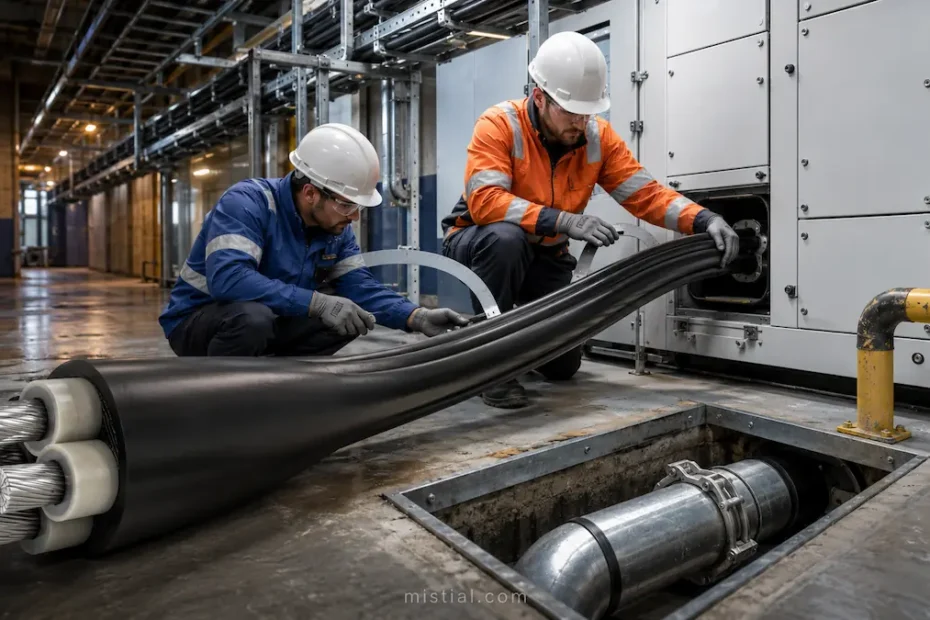
Space around bends and panel entries should be checked on the drawing before the cable size is finalized.
The manufacturer lists a minimum bending radius of seven times the cable outside diameter. On a large power cable, that requirement can take up considerable space inside an electrical room or near switchgear, particularly when several cables enter from the same direction.
Conductor sizing also needs more than an ampacity table. Designers normally have to consider route length, voltage drop, ambient conditions, cable grouping and expected load. Changing conductor size later becomes difficult once trays, glands and termination space are fixed.
For export and project supply, the insulation, sheath and flame-performance requirement should also be written clearly into the specification. Tengyuetong notes that low-smoke zero-halogen, flame-retardant and fire-resistant versions can be produced for specific applications, but those options should not be assumed to be part of the standard construction.
The Tengyuetong Cable range covers rare-earth aluminum alloy cables for low- and medium-voltage applications, including armoured and fire-performance constructions.
A reliable aluminum alloy power cable supplier should be able to discuss where the cable will be installed, not only how many square millimetres the conductor needs to be. The installation route usually tells you which construction is appropriate.
