


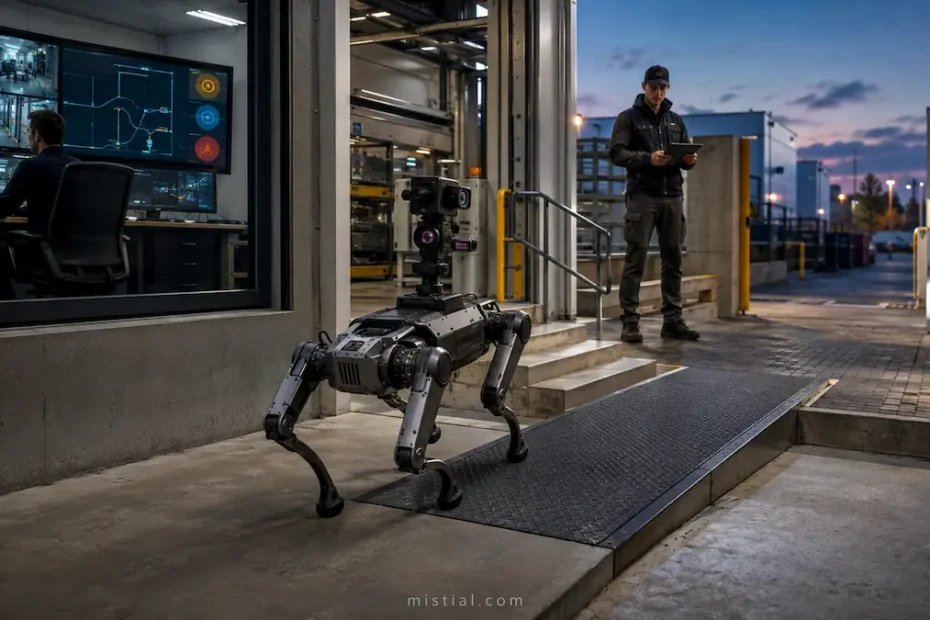
A security patrol robot dog is easy to demonstrate in an open area. Real deployment is harder.
A working patrol route may include stairs, narrow passages, uneven ground and blind corners. If remote video or centralized management is required, network coverage should also be checked along the full route.
Sunnoyal’s Robotic Dog supports autonomous patrol, fixed-point patrol and remote-controlled patrol. Its management system also includes temporary, scheduled and periodic task execution, alarm records, real-time video and playback functions.
For a security project, route design should be tested before patrol frequency is discussed.
Sunnoyal lists a maximum obstacle-climbing height above 16 cm, slope capability above 30°, a 35 cm forward trench-crossing distance and a 1–2 hour endurance figure for the compact patrol model. Those specifications provide a useful starting point, but the real site still needs to be walked and measured.
Stairs, thresholds and ramps are not identical just because their dimensions look similar on paper. Surface grip, turning space and approach angle can change whether a robot completes the route consistently.
Monitoring payload is another important part of the system.
The platform described by Sunnoyal receives feeds from four visible-light cameras and one thermal-infrared camera. It also supports environmental information such as temperature, smoke and PM2.5, together with recognition functions for people, vehicles and selected site events.
Those functions become more useful when the alarm logic is tested under real site conditions. Sunnoyal’s system supports customizable alarm thresholds and different alarm priorities, but the settings still need to match the environment where the robot will operate.
Alarm thresholds should be tested on site so that operators receive useful warnings without being overwhelmed by routine events.
The wider Sunnoyal website presents the company as a China robot dog manufacturer and intelligent-equipment supplier offering quadruped robots together with sourcing and customization support.
Before acceptance, I would run the same patrol route repeatedly and review the alarms, video and task records with the operators who will use the system.
A robot that completes the route once is a demonstration. A useful patrol system needs to repeat the task reliably under normal site conditions.
