


This representative was discovered in 1770 by the Russian traveler Samuel Gottlieb Gmelin. It belongs to the genus of eared hedgehogs of the hedgehog family. A relatively small representative, which is in the Red Book of some countries.
Appearance
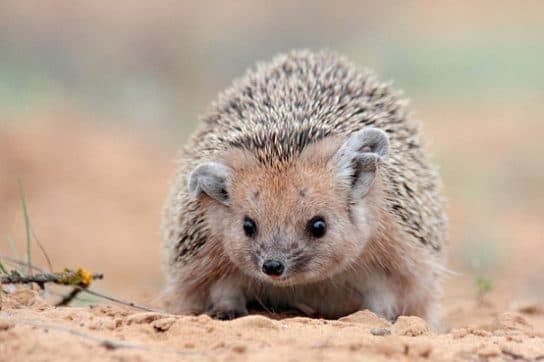
The long-eared hedgehog is a rather small representative of hedgehogs with a body length of 12 to 27 centimeters and a tail up to 2 centimeters. The weight of these hedgehogs ranges from 200 to 500 grams. They have large ears on their heads with a length of up to 5 centimeters. The muzzle is elongated, grayish-black in color. There is a small stripe without hair on the forehead. The coat itself is black-gray or brown-light shade. On the back there are short and sharp needles with longitudinal ridges. The needles themselves can be either light or dark. The body is rounded with long limbs and a short tail.
Sexual dimorphism in eared hedgehogs is very weak, females have practically no external differences from males.
Habitat
The eared hedgehog has spread in many countries of southeast Europe, Asia and North Africa. Many species live in the deserts and steppes of Kazakhstan. In the Russian latitudes, it is found on the territory of the Volga steppes, Tuva and western Siberia. A small part of these animals are located in Ukraine. Dry clay or sandy lands are chosen as habitats.
Nutrition
Most of the diet of eared hedgehogs consists of various small insects. They can be found eating various varieties of beetles, earthworms and insect larvae. In the steppe regions they find food for themselves in the form of lizards, frogs, rodents and chicks. They can feed on fruits, berries and plant seeds. Eared hedgehogs are immune to many types of poisons, so poisonous snakes and beetles can be present in their food, which produce a dangerous poison called cantharidin.
Eared hedgehogs can live for quite a long time without food or liquid. Studies say that they can stay in this state for up to 10 weeks.

The eared hedgehog is remarkable for its ability to run quickly, in comparison with other types of hedgehogs. If a predator appears, the hedgehog bends its head and makes hissing sounds. He is also able to prick the enemy with his needles.
How to feed an eared hedgehog – video
Breeding period
The breeding period can vary depending on climatic conditions. For example, inhabitants of southern countries start the period in July, while residents of colder regions start in April. After mating, the female drives out the male and begins to actively search for or build a burrow for her future offspring. Pregnancy lasts about 45 days. As a rule, from 4 to 7 defenseless hedgehogs are born. Cubs do not have a needle and wool cover, sight and hearing. However, in the back area, you can see a small groove with small dots – the rudiments of needles. After a week, small hedgehogs learn to crawl. After 14 days, they gain hearing and sight, and can also leave their burrows to bask in the sun.
For the first 2 months, eared hedgehogs feed on mother’s milk. After a month and a half, they become almost completely independent. Females become sexually mature in a year of life, and males – in two years. In natural conditions, their life expectancy varies from 3 to 6 years.

Lifestyle and behavior
The period of activity of eared hedgehogs is at night. During the night, they can walk about 9 kilometers. In the daytime they prefer to rest or sleep in their burrows. As a rule, they hide in holes specially dug in the ground, under the roots of trees, stones or bushes. Burrows of eared hedgehogs can be up to 150 centimeters deep. Most often, they prefer to inhabit the already constructed burrows of gerbils, foxes and other mammalian species.
The main enemies of these hedgehogs are such animals as birds of prey, badgers, foxes and wolves. On the body of eared hedgehogs, ixodid ticks parasitize, which are the causative agents and carriers of the disease piroplasmosis, which is dangerous for pets.

From the beginning of autumn, eared hedgehogs begin to actively feed in order to accumulate a sufficient amount of fat for hibernation. The hibernation itself begins from November to April. During this time, eared hedgehogs can wake up several times and even look for food for themselves. This period is typical only for those hedgehogs that live in cold regions. Southern eared hedgehogs can hibernate only if there is not enough food.
Interesting Facts
- It is noteworthy that eared hedgehogs are good orderlies of agricultural land, as they feed on a variety of parasitic insects and rodents. Especially if they live near human settlements.
- The species of eared hedgehogs is listed in the Red Book of Ukraine and Russia in the lists of animals in need of protection. Many species of these hedgehogs are artificially bred in many reserves. An important reason for the decline in their numbers is the destruction of their natural habitat – dry steppes.
- It is believed that these animals inhabited our planet several million years ago, and their appearance has survived to this day.
- Due to their fast running, predators may not catch up with this small, agile hedgehog.
- During the breeding season, males are able to make sounds similar to singing.
- Eared hedgehogs are very resistant to severe temperature changes.
