


Tarbagan or Mongolian marmot is a mammal. It belongs to the family “squirrels”, the order “rodents”, the genus “marmots”. For the first time, the Mongolian marmot was described by the Russian naturalist Gustav Radde (1862).
Two subspecies are distinguished: common and Khangai tarbagan.
Appearance
The body of the tarbagan is 56.5 centimeters long, and the tail is 10.3 centimeters. Weighs about seven to eight kilograms. By the end of the summer season, weight increases, and a fourth of it is fat accumulation.
The head is similar to that of a rabbit and sits on a short neck. The forehead is narrow and high, the cheekbones are wide. The tubercle behind the eyes is much less pronounced compared to other species. The ears are small in size and round in shape. The marmot has excellent hearing, smell and vision. Cheek pouches are missing.
The marmot has a soft and short coat. The color is yellow-gray, the tips of the hairs are dark brown. Underneath the coat has a reddish-gray color. The upper part of the head is colored darker and resembles a hat. Cheeks and where the vibrissae are located, the gap between the ears and eyes of lighter tones. The tail is the same color as the back, but at the end it is dark or gray-brown.
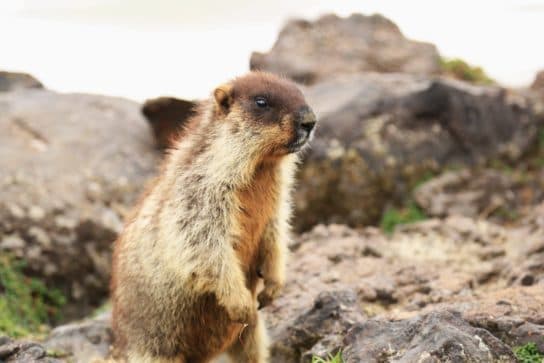
The incisors are well developed. The paws are short and equipped with long claws for digging the ground.
Tarbagans, which live in the northern regions, are smaller in size.
Where dwells
The habitats of the tarbagans are:
- in alpine meadows;
- in mountain and forest steppes;
- in semi-deserts;
- river basins and valleys;
- in the bushes.
Their favorite habitats are the steppes in the mountains and near the mountains, as there is enough food in such areas.

Mongolian marmots migrate. When the vegetation burns out, they move to shady areas. Biological processes associated with seasonality affect vital activity and reproduction. When making forage migrations, tarbagans can move to heights in the range of thousands of meters. Rodents select such habitats where there is good visibility, that is, in the steppes with low-growing grass.
The common tarbagan lives in Eastern Mongolia, China and Transbaikalia. And in Tyva (Russia), in the central and western parts of Mongolia, the Khangai tarbagan lives.
What eats
Tarbagans, having got out of their burrows in the spring, must feed in such a way as to accumulate more fat for the onset of cold days. They eat:
- Steppe herbs;
- roots;
- berries;
- woody plants.
They eat while sitting on their hind legs, and keep food in their front legs. The seeds in the fruits of plants are not digested, and marmots sow them together with their feces, which are fertilizers, thereby improving the steppe landscape.

In one day, the Mongolian marmot eats one and a half kilograms of plants. Together with plants, the animal absorbs crickets, snails, caterpillars, grasshoppers. They drink very little.
Lifestyle
Marmots unite for life in small colonies. They consist of a married couple and their offspring born in the previous two to three years. If there is enough food in the area of their habitat, then in the colony there can be up to 18 individuals, and if there is not enough food, the number decreases three to four times.
With insufficient feed, tarbagans carefully guard their possessions and do not allow other people’s marmots into them. If there is enough food, then they are calm about the presence of neighbors and are not aggressive.
Animals communicate using specific sounds. If a predator approaches, the tarbagan makes a whistling sound. In case of an alarm signal, all the animals run to their holes and hide.

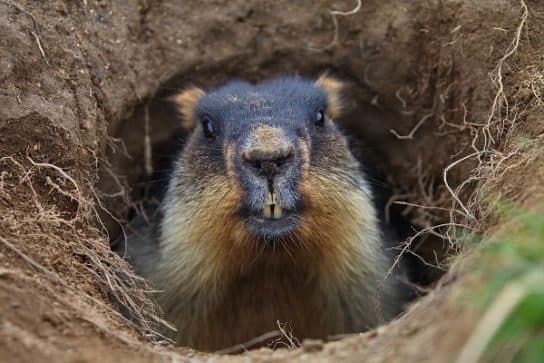
Tarbagans build deep burrows. The burrow is made in the form of one large camera. For the winter period, the exit is closed with a plug of mud and grass. There are earthen mountains near the burrows of Mongolian marmots. They are called marmots (butanes). Marmots reach heights of up to one meter, and are 8 meters or more in diameter.
For eating, the tarbagan leaves the burrow in the evening. By the fall, marmots that have accumulated enough fat are resting on the surface of marmots, and those who have not gained fat accumulations graze on grasses.
When cold weather sets in, tarbagans practically do not leave their burrows. Before hibernation, the animals prepare bedding in the winter chamber. In winter, they hibernate.
Reproduction
Marmots breed in the colony where they live. It happens that families are formed outside the colony. Reproduction can be carried out from the age of three, although tarbagans reach sexual maturity by two years.
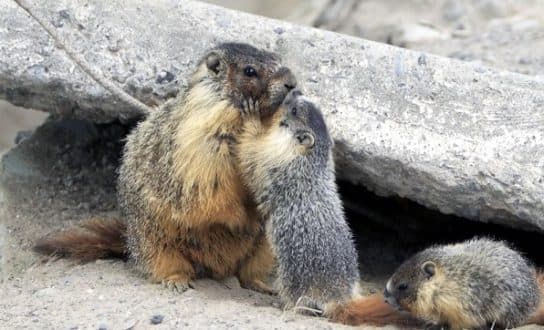
Mating takes place in burrows in early April. In females, gestation lasts about 40 to 42 days. The offspring appears in the amount of 4-8 cubs. Babies are fed with mother’s milk for about six weeks. From the month of life, they already begin to eat plant foods. In the nesting chamber, both parents and other marmots living in the burrow take care of the cubs.
Enemies of the Mongolian Marmot
In nature, the enemies of the marmot are such representatives of birds of prey as golden eagles, steppe eagles, hawks, buzzards. Predatory mammals also love to eat tarbagan meat. Marmots are hunted:
- wolves;
- snow leopards;
- brown bears;
- foxes;
- light ferrets;
- corsacs.
Tarbagans are harmed by lice, fleas and ticks, larvae of skin gadflies, nematodes, coccidia. Such parasites can lead the animals to complete exhaustion or to death.
Mongols, Buryats and Tuvans hunt tarbagans, as they use them for food and for the preparation of medicines.
Population and status
Over the past hundred years, the tarbagan population has declined. In particular, a large reduction in the species is observed in the Russian territory. The main reasons are: hunting for tarbagan, development of the Trans-Baikal virgin lands, extermination in order to prevent infection with plague (he is a carrier of the disease).
The number of animals is decreasing because the local population is constantly hunting them. Tarbagans move to the territory of Russia from Mongolia. Due to this, their number is still maintained.
In the nineties, hunting for tarbagans in Mongolia led to a sharp decline in the population. This species has been categorized as endangered.
Security measures
Now on the territory of our country in the Trans-Baikal Territory and Buryatia, the Mongolian marmot is under protection. Two reserves (Sokhondinsky and Daursky) and two reserves (Borgoisky and Orotsky) have been created. The animal is listed in the Russian Red Book.
In Mongolia, the tarbagan is included in the list of rare species of animals and it is allowed to hunt for it only two months a year. An interesting fact is that monuments were erected to Tabargan in the following cities:
- Krasnokamensk. The composition represents two figures of an animal in the guise of a hunter and a miner.
- Angarsk. The sculpture symbolizes the production process for the manufacture of fur hats, which began at the end of the last century.
- Tuva (near the village of Mugur-Aksy). A large composition of two figures of tarbagans.
- Ulan Bator and the Eastern aimak (the monument is made of traps).
The preservation of tarbagans is necessary due to the fact that their vital activity has a positive effect on improving the flora. Marmots play a key role in the favorable development of biogeographic zones.
