


Umbelliferae plants are one of the most common in agriculture. This huge family has an impressive number of genera and species – taking into account the fact that it is distributed in almost all parts of the planet. However, the most amazing thing is the variety of umbrella: some of them are grown in summer cottages, and some are deadly poisonous, and are used in medicine.
In total, science knows about three thousand species of this family and more than three hundred genera of such plants, which are usually presented in the form of perennial grasses, but shrubs with trees are also found among them.
Types of umbrella plants
Astrantia
Hemlock

Володушка

Angelica officinalis

Sowing coriander

Kinza

Lovage

Carrot

Sowing parsnip

Parsley

Dill

Celery

To dream
Fennel ordinary

Heteromorph

Alpine erythematosus

Erythematosus flat-leaved

Characteristics of umbrella
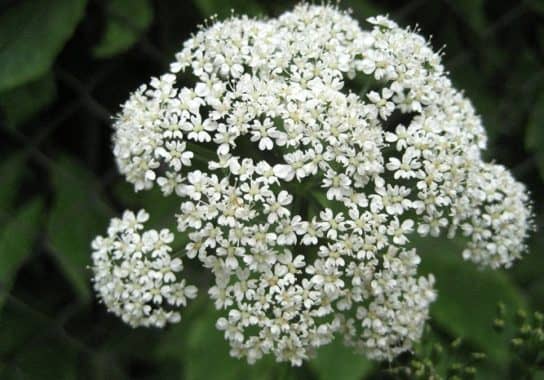
Most of the umbelliferae can be recognized by the very characteristic inflorescences, from which they got their name. These are simple or complex umbrellas, called the head, with small flowers, as a rule, white in color (although sometimes they are yellow or blue), with a barely noticeable cup.
The plants are distinguished by a double perianth and five sepals on the corolla, with one pistil containing two carpels. Umbrella fruits are called subcolumn – this is a bipartite achene in the form of a divided pad. And it is the fetus that plays a decisive role in recognizing this family. Most of the plants of this species practically do not differ from each other – usually experts distinguish them by the shape of the inflorescence, by the presence of a wrapper and other small details.
The most common representatives of the umbrella, which most of us encounter almost every day, are usually divided into:
- household or vegetable, which include dill, parsnips, carrots and many other food and household plants of the family;
- Poisonous, medicinal – hemlock, poisonous milestones and others;
- Essential oil, which includes herbs used as spices (cumin, anise, etc.)
Poisonous umbrella
Some species of umbrella are mortal danger not only for humans, but also for farm animals – they are not only not recommended to grow in any form (decorative or any other), but also dangerous to use. Therefore, you need to be extremely careful with all unfamiliar plants.
First of all, this is due to the fact that, in addition to dangerous for livestock, there is a huge number of plants from the umbrella family, inaccurate behavior with which, in addition to dangerous poisoning, can threaten more serious problems.
Hemlock
The most famous of the poisonous umbrella are hemlock, poisonous milestones (aka cicuta), hogweed, belladonna. All these plants have been known for their poisonous properties for over a thousand years – and more than one person paid with their lives for careless handling of them.

Milestone poisonous
But you should definitely take into account one important point. All these plants, although they are highly poisonous, are used in the composition of many medicines and preparations in view of their irreplaceable and undeniable medicinal properties. However, any attempt to use them in food or self-medicate in an arbitrary manner is prohibited under threat of death.
Medicinal umbrella
Umbrella – plants, representatives of which can both provide undeniable benefits and bring significant harm to the body. It is the umbrella that is often used in medicine to treat a number of diseases. And a huge number of species of this family are known for their healing properties, which were recognized not only by traditional medicine, but also by representatives of the official one.
Many of them have both antiseptic and antispasmodic capabilities, and are also used in the composition of both medicinal and tonic agents, helping to increase the resistance and immunity of the human body.
As an antiseptic, for example, it is customary to use onions, violets, sap, roses, persimmon, aspen and many others from the well-known plants of this species.
Dill
Many of the umbrella are endowed with medicinal properties due to the content in them of such a substance as coumarin and its various derivatives (the same dill). Many of the poisonous plants of the family are used as medicines, because their properties are truly unique.
Conclusion
As a rule, plants of the umbrella family prefer to grow in temperate or subtropical climates, so most of them can be found in Europe, America or at latitudes of Asia. Sometimes these perennials grow in tropical countries, however, there they choose mountainous areas. Their greatest concentration reaches the temperate zone of the Northern Hemisphere, and on its territory – in the countries of Asia. In the Russian Federation, there are about 110 genera and three hundred species of this family.
