


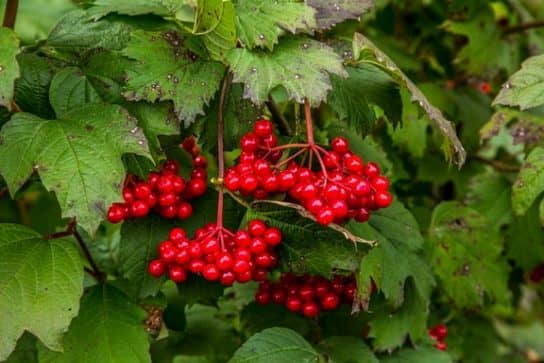
In each climatic zone, you can find many beautiful, useful and unique plants peculiar only to it. The temperate climate encourages the growth of a large number of wild and cultivated flora, for example, the common viburnum. This deciduous shrub is also called red viburnum for the bright scarlet color of its fruits. All parts of this amazing plant have found their application in many areas of human activity: cooking, medicine, paint production and others.
Appearance and description
Viburnum belongs to the adox family of the dicotyledonous class. Its bushes are more reminiscent of small trees, as they reach a height of 4 meters (usually 1.5-2.5 m). The bark of the trunk has a gray-brown hue and longitudinal cracks. The shoots of the shrub are rounded or ribbed in places and have a grayish or brownish-yellowish color. The red-green buds are ovoid and slightly pointed.
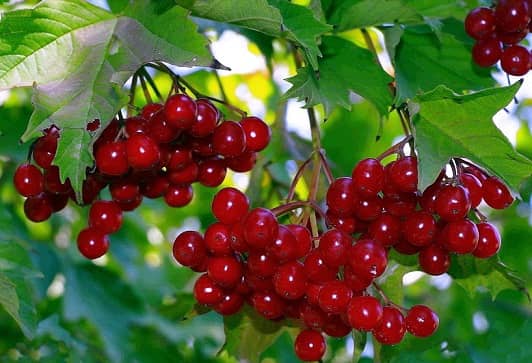
Shoots on which fruits do not ripen end in a single bud. Fruit shoots have two false-end buds at the end, between which the shoot tip is clearly visible. The plant has a developed and very strong superficial root system.
Viburnum is a perennial plant, and it is long-lived (it can live up to 50 years or more). It rarely grows alone, usually in whole thickets with hanging side branches.
Leaves, flowers and seeds

The leaves of the viburnum are large, wide, whole, divided into three or five lobes, have an opposite arrangement on the shoots. Young leaves are light green, in summer they turn bright green, and by autumn they acquire a reddish, sometimes quite bright shade. The width of the leaf is approximately 6-7 cm.
Small white flowers of red viburnum are combined into corymbose inflorescences. The flower stamens rise strongly above the corolla and have yellow anthers. Viburnum blooms on average about two weeks and occurs in late spring: from late May to early June. Pollination is carried out with the help of insects.

Then, in place of the flowers, spherical red fruits with a diameter of about 1 cm begin to form. They are edible and have a bitter taste, which disappears with the onset of frost. Fruits ripen in August or September, giving large flattened seeds from 7 to 9 mm long. Various birds feed on them, thereby facilitating the movement of seeds over long distances.
Distribution and habitats
The common viburnum is widespread within the temperate zone of the Earth. It is found in America, Europe, Asia. In Russia, it grows in the European part, in the Crimea, in the Caucasus, in Western and Eastern Siberia. It lives everywhere in a variety of biotopes: on the banks of water bodies, in forest areas, in clearings, clearings, swamps.

Viburnum is an extremely light-loving plant that will not bear fruit in shade conditions. However, it is capable of carrying a light shadow. It is quite unpretentious in terms of conditions and care, it tolerates dry summers and frosty winters well.
Characteristics and application
Viburnum is a storehouse of useful biochemicals. The organs of the plant contain many vitamins and other trace elements that are beneficial to health and are used for various purposes. For example, the fruits and bark of a plant are valuable raw materials for the production of medicines.

The roots contain vitamins C, K and essential oils. The shoots also contain essential oils, as well as tannins and salicin, which is known for its pain, inflammation and swelling properties. The bark contains useful carbohydrates and various organic acids, including some essential fatty acids (oleic, linoleic, stearic, and others). The leaves also contain many vitamins, acids, tannins. Flowers are rich in a number of flavonoids, and fruits contain almost all possible compounds: vitamin C, potassium salts, higher fatty acids, carbohydrates, and so on. The seeds contain a large amount of fats and EFAs.
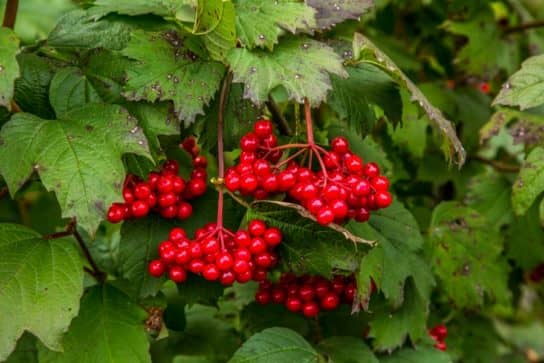
The bark and fruits contain substances used to dye tissues in black-green and red, respectively. Viburnum berries are used in cooking for making drinks, seasonings, vinegar, marmalade. The medicinal uses of this plant are even wider. Viburnum is used to make sedative and hypotensive infusions, decoctions to fight inflammation, form antidiabetic preparations, and with the help of drops and inhalations from viburnum extract they successfully fight sinusitis, tonsillitis, tracheobronchitis and laryngitis. This is only a small part of the plant’s medicinal uses.
Planting and leaving
Kalina for its unpretentiousness and aesthetically pleasing appearance is often planted in parks and gardens. It is not very demanding on the soil – it grows well on podzolic and sandy loam soils, and also calmly tolerates exhaust gases and low temperatures.

Viburnum should be planted in well-lit areas. It can be planted even on slopes, as its powerful root system perfectly strengthens the soil and protects it from erosion. In places where groundwater is close and where water of a different kind is accumulated, viburnum has proven itself perfectly.
Viburnum propagation is carried out both by seeds and cuttings (vegetative method). When planting in a private garden, the second option is more often used. Layers from low-growing branches of viburnum are planted in pits at a distance of 1.5-2 m from each other either in spring (April) or in autumn (October).

Caring for this plant consists in abundant watering, since it loves moisture and easily tolerates its excess. Twice a year, fertilizers must be applied to the soil: the first time in the spring before the growing season, and the second before the autumn leaf fall. Also, the soil around the shrub is loosened and mulched with hay or sawdust. Rejuvenating pruning is done at the beginning of winter or after it, but before the onset of the growing season. Old branches are cut at a distance of 15-20 cm from the surface of the earth.

Since viburnum is often used for decorative purposes, several cultivated subspecies have been bred. They differ in the shape and color of inflorescences and fruits. And the rich chemical composition of the plant allows it to fight molds, viruses, pathogenic bacteria and various diseases with its help.
