


Turnip is an edible root vegetable belonging to the Cabbage genus of the Cabbage family. It is mainly grown in temperate climates. She is known for her bitter taste. The roots and leaves contain valuable nutrients and components. The famous Roman philosopher Pliny considered it to be one of the most important food products of his time.
Recently, such a food product has long been forgotten and cannot be found “in the afternoon with fire” in modern cities. But even in Russia no dinner could be imagined without a turnip. And rightly so did the consumer who did not forget the product sung in fairy tales even after the appearance of the “newfangled” potato. Fortunately, interest in this vegetable crop is reviving all over the world.
What does turnip look like and where does it grow?
There are many varieties of turnip and depending on this, it can be slightly yellowish or light purple on the outside, but on the inside it is mostly always white.
Refers to annual or biennial herbaceous plants.
Despite its wide popularity in Russian folklore, the homeland of this vegetable is still the territory of Western Asia.
The most valuable part is the root crop. Depending on the variety, it can have a pure white or yellowish flesh color. With respect to the form, turnips are distinguished:
Round;
Elongated;
Flat.
In turn, root crops are divided into:
Canteens (flat and rounded);
Fodder (elongated species are also called “turnips”).
By the timing of ripening, it happens:
- Mid-season (a high-yielding species, which is also the most popular, includes the “Petrovskaya” variety);
- Early ripening (there are varieties of turnip “White Nochka” and “May White”).
In the first year of growth, only a basal rosette and an edible fleshy root appear.
In the second year, a long aerial stem is formed, strewn with green leaves and flowers during the flowering period.
If there is a desire to grow a vegetable on your own and get seeds, then it is worth considering:
- It is better to store them by mixing in a sandy ground;
- Planting is done in early spring;
- The best places for sowing are sunny areas;
- The most suitable soil is considered to be sandy and light loamy.
Turnip is one of the most ancient vegetable crops. It was cultivated 40 centuries ago.
For the first time, this root crop began to be used in ancient Egypt and Greece, where it was considered food for the poorest segments of the population and slaves. Unlike the Egyptians and Greeks, among the inhabitants of Ancient Rome, she was present at the tables, regardless of their status in society. They preferred baked turnips. Later, the vegetable spread to Western Europe.
In Russia, until the beginning of the 18th century, turnip was considered the main food product, which was later replaced by more productive potatoes.
Chemical composition and calorie content
This vegetable culture has become famous and popular among the population for a reason. After all, this root crop belongs to a product rich in useful substances, which has now been confirmed by scientists. It is a source of many nutrients, including phytonutrients, flavonoids and other compounds, which makes it very beneficial for our health.
Turnip pulp contains:
- Water (not less than 90%);
- Vegetable proteins;
- Fats;
- Carbohydrates (represented by mono- and disaccharides);
- Organic acids;
- Mustard oil;
- Dietary fiber (or fiber);
- Retinol (vitamin A);
- Provitamin A (beta-carotene);
- Some B-vitamins (riboflavin, thiamine, niacin);
- Tocopherol (vitamin E);
- Vitamin C (ascorbic acid);
- Minerals in the form of calcium, potassium, magnesium, manganese, iodine, phosphorus, sodium, iron.
The calorie content of 100 g of fresh turnips is about 32 kilocalories. Therefore, the vegetable is classified as a low-calorie dietary product.
Beneficial features
In addition to nutritional value, turnip has a number of beneficial properties. She has always been not only a food product, but also a medicine. Due to the presence of some compounds in its composition, it possesses:
Diuretic;
Anti-inflammatory;
Antiscorbutic;
Antiseptic;
Pain relievers;
Expectorant;
Soothing
properties.
Including it in your diet, first of all, you can protect your body from viruses and bacteria, increase resistance to infectious diseases.
Turnip benefits
It is well known to nutritionists and physicians that the introduction of turnips into their diet contributes to:
- Relief of pain in arthritis and rheumatism;
- Prevention of joint pain;
- Normalization of blood glucose levels (on the one hand, the product itself does not have a huge sugar content, on the other hand, it contains an active valuable substance called glucoraphanin);
- Mild removal of chronic constipation (only turnip will not work immediately, but gradually; as a result, the dosage should be small);
- Prevention of the emergence and development of cancer;
- Removal of increased nervous excitability;
- Improvement of visual function (the risk of myopia, “night blindness”, hyperopia decreases);
- Removal of kidney stones;
- Removal of puffiness (has a diuretic effect);
- Prevention of the development of any cardiovascular disease;
- Effective treatment of many diseases of the respiratory system (tuberculosis, asthma, bronchitis, pneumonia);
- Removal of toothache (rinse the mouth with a decoction of a vegetable);
- Treatment of diseases of the nasopharynx (the throat is also rinsed with a decoction);
- Prevention of baldness;
- Prevention of early gray hair.
It promotes additional testosterone production in men. It is on him that the sexual activity of a man depends.
How to cook turnips
Of course, the most useful is raw, not thermally processed, which is most often added to vegetable salads. After all, it is the raw version that retains the maximum amount of components useful for the human body.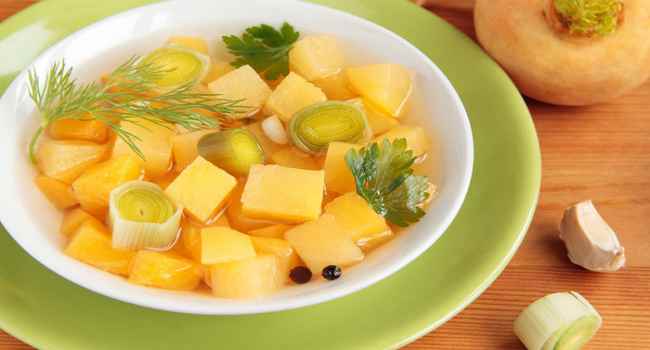
But culinary experts claim that a baked or steamed root vegetable is no less useful. Especially tasty turnips steamed in the oven, which can be replaced by the oven.
You can:
- Add to millet porridge;
- Stuff with meat, vegetables or any kind of porridge;
- Cut into slices and fry;
- Making casseroles;
- Add to stew;
- Prepare side dishes for regular meat (beef or pork), poultry and fish (they are no different from mashed potatoes);
- Add to dessert dishes (turnip goes well with honey and raisins).
Contraindications and side effects
Contraindications to its inclusion in your diet in the general planet. True, such a positive quality applies only to the consumption of turnips, which are thermally processed and characterized by a delicate soft pulp structure.
When it comes to raw fresh turnips, people with:
- Any disorders in the work of the gastrointestinal tract;
- Liver dysfunction (especially with hepatitis and cholecystitis);
- Chronic kidney disease;
- Severe serious nervous disorders.
How to choose and store
Turnip grows small. Such root vegetables are juicy and tasty. Overgrown can be fibrous. When choosing in a store or on the market, you need to pay attention precisely to the size of the root crop.
It should not be lethargic, stained, and there should be no signs of deterioration.
It is stored for a long time. Place it in a bag in the refrigerator. If stored in a basement, sprinkle with sand.
The healing properties of turnip
Turnip juice and decoction are used as an expectorant. The juice, like radish juice, helps to remove salts from joints, relieve pain and improve mobility.
To prepare a decoction, you need:
Grate turnips;
Brew 2 tablespoons of the resulting pulp with a glass of boiling water;
Insist for 15 minutes;
Strain and drink 50 ml 3-4 times a day.
The broth improves the discharge of phlegm from the bronchi, helps to cope with insomnia, drink with constipation.
Application in cosmetology
Masks, lotions obtained from decoctions of vegetables and fruits have always been used by women to improve their appearance and help them maintain their beauty and youth.
Turnip juice helps to strengthen hair follicles, improve their growth, and prevent hair loss.
Steamed radish gruel can help treat acne and oily skin, smooth wrinkles and improve overall skin tone.
For dry skin, add olive oil or another cosmetic oil.
